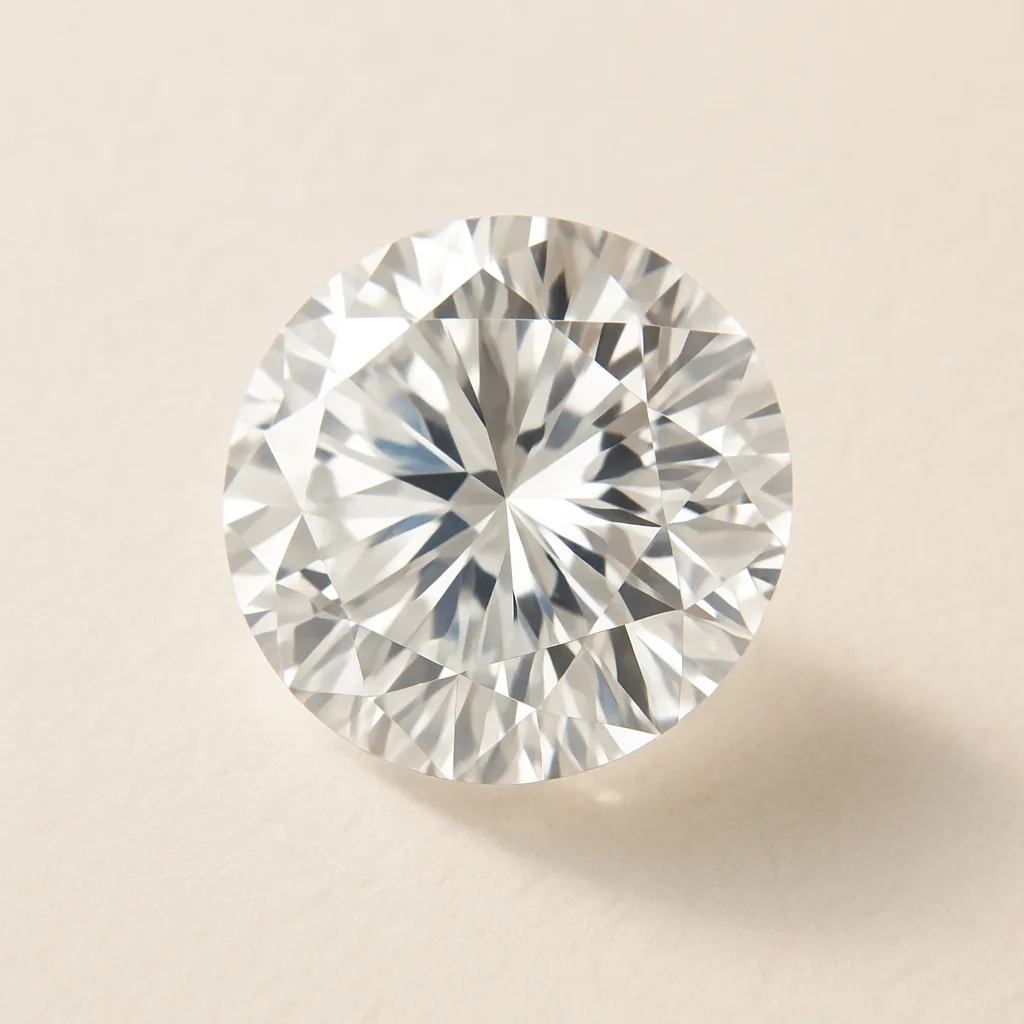
identified this stone yet
Cubic Zirconia
| Hardness | 8-8.5 |
| Specific gravity | 5.60-6.00 |
| Refractive index | 2.150-2.180 |
| Crystal system | 等軸晶系 |
Standard CZ is colorless, water-clear, cut to round-brilliant proportions optimized for diamond-style fire and brilliance. Doped color variants are produced commercially in essentially every gem hue — 'CZ ruby,' 'CZ sapphire,' 'CZ emerald,' 'CZ alexandrite' (though the alexandrite variant is actually vanadium-doped synthetic corundum, not CZ — another name confusion). The colorless variety dominates commercial supply by an enormous margin and is what the term 'CZ' implies absent qualification.
- Generally clean — most commercial material is essentially flawless to 10× inspection
- Rare residual gas bubbles from the skull-melt process, when present diagnostic of synthetic origin
- Faint curved growth lines in some material, distinguishable from natural growth zoning under careful 30× immersion
- Singly refractive (cubic system) — no at any orientation
- Refractive index 2.15–2.18 — high but below diamond's 2.42
- 0.058–0.066 — significantly higher than diamond's 0.044, producing the characteristic 'over-coloured' fire that distinguishes CZ from diamond visually
- Specific gravity 5.6–6.0 — substantially heavier than diamond (3.52), giving immediate hand-heft difference at 1 ct and above
- Adamantine luster
- 01Specific gravity 5.6–6.0 gives immediate hand-heft test against diamond (3.52) — a one-carat CZ weighs noticeably more than a one-carat diamond and looks proportionally smaller
- 02Excessively colorful fire ( 0.058 vs diamond's 0.044) — the 'rainbow effect' is a CZ-vs-diamond visual signature trained gemologists identify in seconds
- 03Thermal conductivity probe reads 'not diamond' (CZ has roughly 1/200 of diamond's thermal conductivity)
- 04Read-through test: a line drawn on paper is visible through a CZ stone (RI 2.15) where it is invisible through diamond (RI 2.42, total internal reflection)
- 05Surface dulling and 'fogging' from cumulative scratches on display-grade jewelry after years of wear — a slow but distinctive aging signature
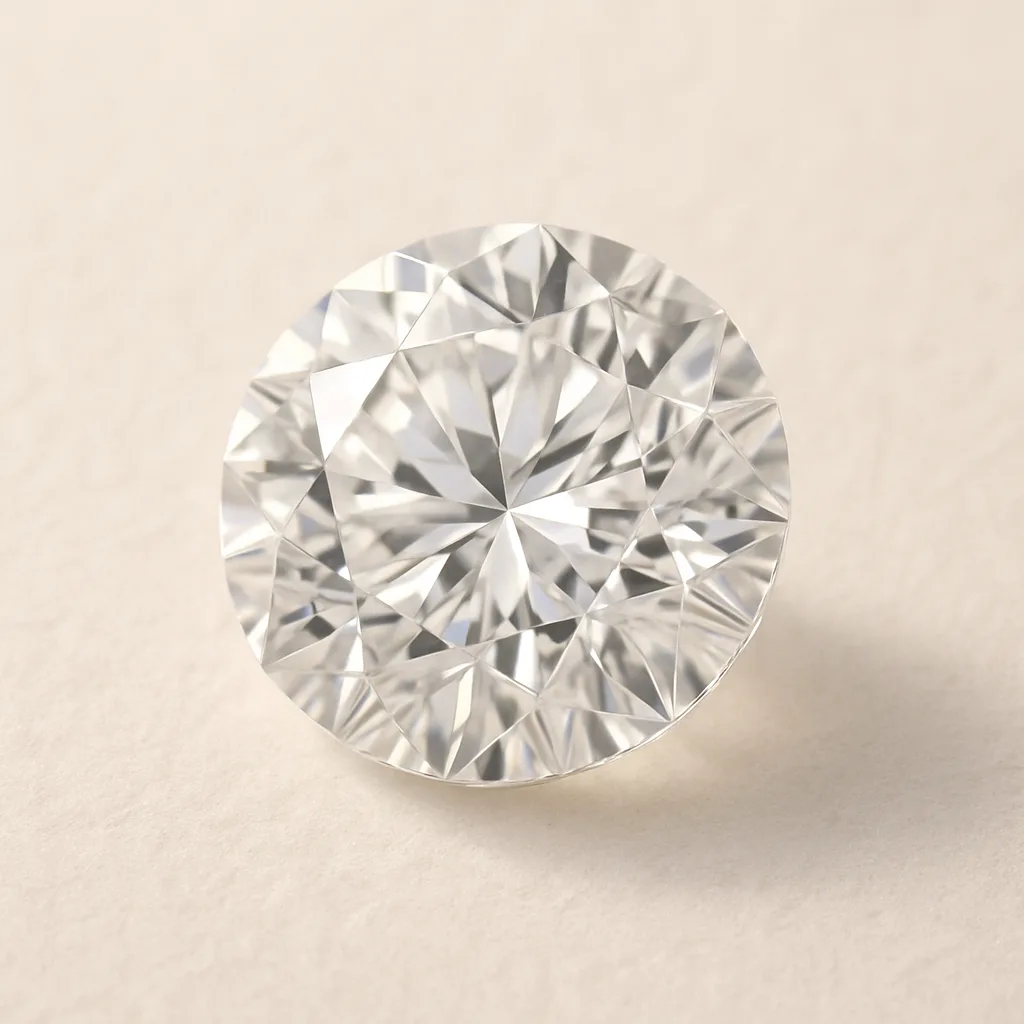
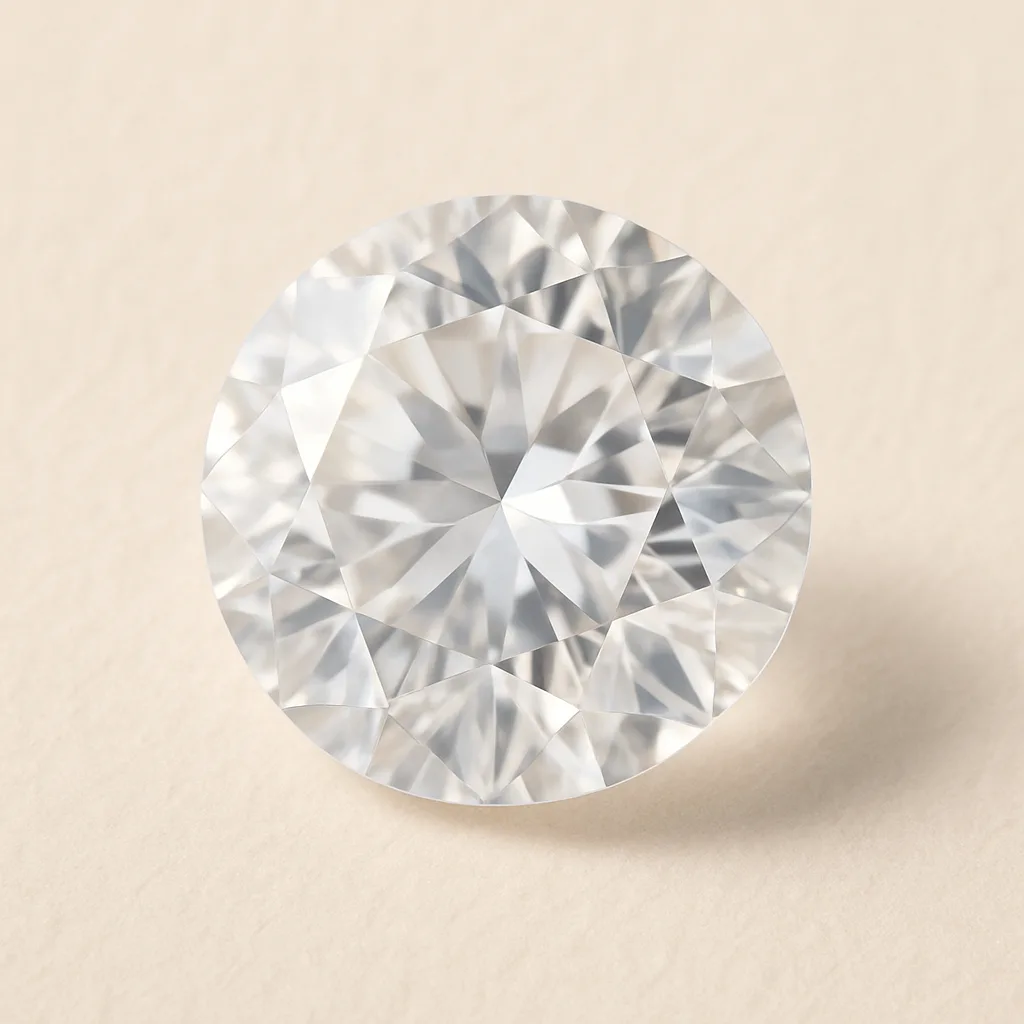
- Mohs 8.0–8.5 — durable enough for ring wear; surface scratches accumulate over years of daily use, gradually reducing brilliance
- Ultrasonic and steam cleaning are safe
- Stable to light and standard household chemicals
- Surface fogging from skin oils accumulating in micro-scratches becomes noticeable in well-worn pieces — periodic professional polishing restores the original brilliance
Loose colorless CZ trades at $1–$10 per carat at the wholesale level; high-precision Russian and Swiss-cut material commands $5–$50/ct. Finished CZ jewelry in sterling silver runs $20–$200; in 14k gold settings $100–$1,000 depending on metal weight. Vintage 'Diamonique' QVC pieces from the 1980s are now collected as period costume jewelry at $50–$300. The price differential against diamond — typically four to five orders of magnitude per carat — is the structural fact that drove CZ's commercial dominance.
Note: Disclosure as 'cubic zirconia,' 'CZ,' 'lab-grown,' or 'synthetic' is mandatory under FTC Jewelry Guides (1996 revision) and CIBJO Blue Book. The trade name 'fianite' should be disclosed alongside CZ in markets where the term might be confused with natural zircon. Critical: 'cubic zirconia' (ZrO₂, synthetic oxide, RI 2.15) must never be sold as or confused with 'zircon' (ZrSiO₄, natural silicate, RI 1.92) — the species are unrelated. Mohs 8.0–8.5 makes CZ durable for everyday wear; the principal degradation mechanism in ring settings is surface scratching from harder materials (diamond, corundum, topaz) rather than chipping. CZ tested with thermal conductivity probes (designed for diamond) reads as 'not diamond' since CZ has much lower thermal conductivity; combined thermal / electrical conductivity testers (which test for moissanite) generally separate CZ, moissanite, and diamond cleanly.
Cubic zirconia is synthetic ZrO₂ — pure zirconium dioxide stabilized in the cubic crystal phase by 8–12 mol% Y₂O₃ (yttria) or, less commonly, CaO or MgO addition. Below 2370 °C pure ZrO₂ would normally invert from cubic to tetragonal and then below 1170 °C to monoclinic baddeleyite, fracturing the crystal in the process; the yttria stabilizer locks the cubic phase down to room temperature and yields a transparent, isotropic, gem-quality crystal. Mohs 8.0–8.5, SG 5.6–6.0 (notably heavier than diamond's 3.52), RI 2.15–2.18, 0.058–0.066 (significantly higher than diamond's 0.044), singly refractive (cubic system). The skull-melt growth process developed at the Lebedev Physical Institute (FIAN, Физический институт Академии Наук) in Moscow uses radio-frequency induction heating to melt ZrO₂ powder inside a 'skull' of unmelted material — the powder is its own crucible, eliminating the contamination problems of conventional crucible growth at the 2750 °C melting point of zirconia. Color-coded variants are produced by transition-metal doping: chromium for green, neodymium and praseodymium for purple-violet, cerium for yellow-orange, manganese for brown, copper-based for various pastels.
Origins
The 1976 commercial breakthrough at the Lebedev Physical Institute (FIAN) of the Soviet Academy of Sciences in Moscow — under the leadership of Vyacheslav Vasilyevich Osiko — established the skull-melt method that remains the universal commercial growth technique. Russian-language markets call CZ 'фианит' (fianite) in honor of the FIAN institute; Western markets adopted 'cubic zirconia' or the trade name 'Djevalite' after Djevahirdjian SA in Monthey, Switzerland (the Djeva company founded by Hrand Djevahirdjian in 1914 for Verneuil ruby production), which licensed the FIAN technology in 1977 for European commercial production. QVC's 'Diamonique' brand became the leading United States retail name from the 1980s onward through Swarovski-supplied finished stones. China (Wuzhou and Guangzhou cutting hubs), Thailand (Bangkok), Russia (continuing FIAN-tradition production), and Switzerland (Djeva continuing as a high-end producer) dominate global supply. Annual world production approached 400 tonnes by 2015 — vastly exceeding world diamond production by mass.
History
nclusions in metamict zircon from Sri Lanka — the natural occurrence is so rare and small that no gem use was ever possible. Soviet research at the Lebedev Physical Institute throughout the late 1960s and early 1970s, building on Bell Labs and IBM crystal-growth work for laser and substrate applications, finally solved the contamination problem inherent in melting ZrO₂ at 2750 °C. The skull-melt method — using high-frequency induction to heat a charge of ZrO₂ powder mixed with metallic zirconium initiator inside a water-cooled copper container, melting the central core while the outer 'skull' of unmelted material acts as a self-crucible — was developed by V. V. Osiko's group and demonstrated commercial gem-quality crystals in 1976. The Soviet Union briefly attempted to monopolize the technology and brand the product 'Djevalite' through the Djevahirdjian Switzerland licensing arrangement, but the technology was effectively reverse-engineered by Chinese and American producers within five years. The 1980s commercial flood drove earlier diamond substitutes (synthetic rutile, YAG, GGG, white sapphire, sometimes glass) entirely out of the mainstream substitute market — only synthetic moissanite (Charles & Colvard 1995) and lab-grown diamond (commercial scale post-2015) have since significantly competed for the colorless-substitute market. CZ also saw genuine scientific use as an oxygen-conductivity electrolyte in solid-oxide fuel cells (yttria-stabilized zirconia, YSZ) and as a thermal-barrier coating in jet-engine turbine blades — applications that drive the bulk of world production by tonnage. The 2015 commercial debut of high-quality colorless CVD lab-grown diamond at $1,000/ct and below marks the first serious threat to CZ's hold on the simulant market in three decades.
Lore & symbolism
Not assigned to any traditional birthstone list (synthetic, no historical precedent). Modern crystal-writing has been slow to assign sacred meanings to CZ given its overtly twentieth-century technological origin; some New Age authors have positioned CZ as a stone of clarity, focus, and mental discipline by analogy to its origin in Soviet and American crystal-physics laboratories. The 'fianite' name in Russian-language markets retains a faint nostalgic association with Soviet-era optical-physics achievement; Western retail markets have generally treated CZ as a pure technological product without folkloric dimension.
Tools to confirm this stone
Tools that help confirm Cubic Zirconia. Tap any item to jump to the matching section on the gem tools page.
- 最終確認日
- 2026年4月28日
- 参 考 文 献
- Gem Encyclopedia/ GIA (Gemological Institute of America)
- 宝石鑑別基準/ 中央宝石研究所 (CGL)
- Mineral & Gem Database/ Mindat.org / Gemdat.org
- 宝石学入門/ 全国宝石学協会
本ページの物性値(屈折率・比重・硬度・結晶系等)は、上記の権威ある一次資料を相互参照して編集しています。最新の鑑別研究の進展により値が更新される場合があります。