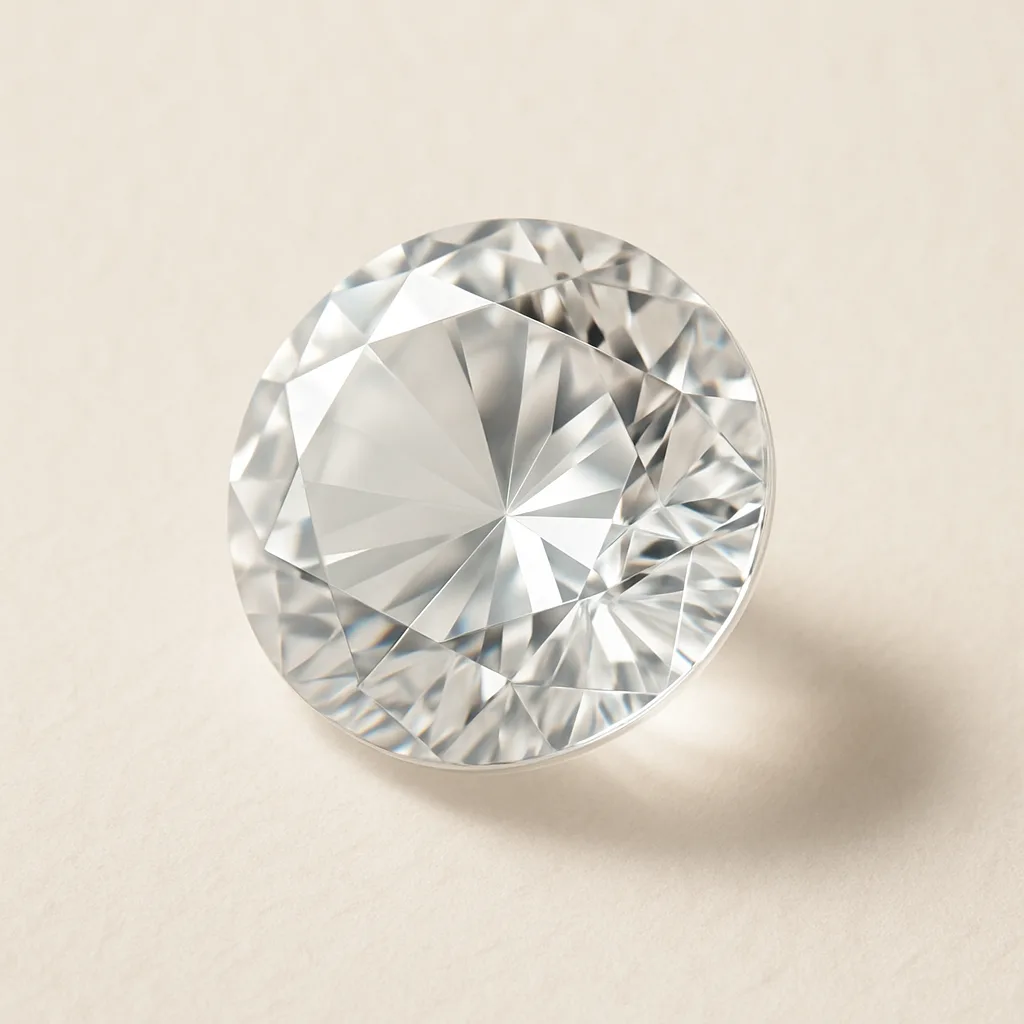
identified this stone yet
Clear Glass
| Hardness | 5-6 |
| Specific gravity | 2.40-3.00 |
| Refractive index | 1.470-1.700 |
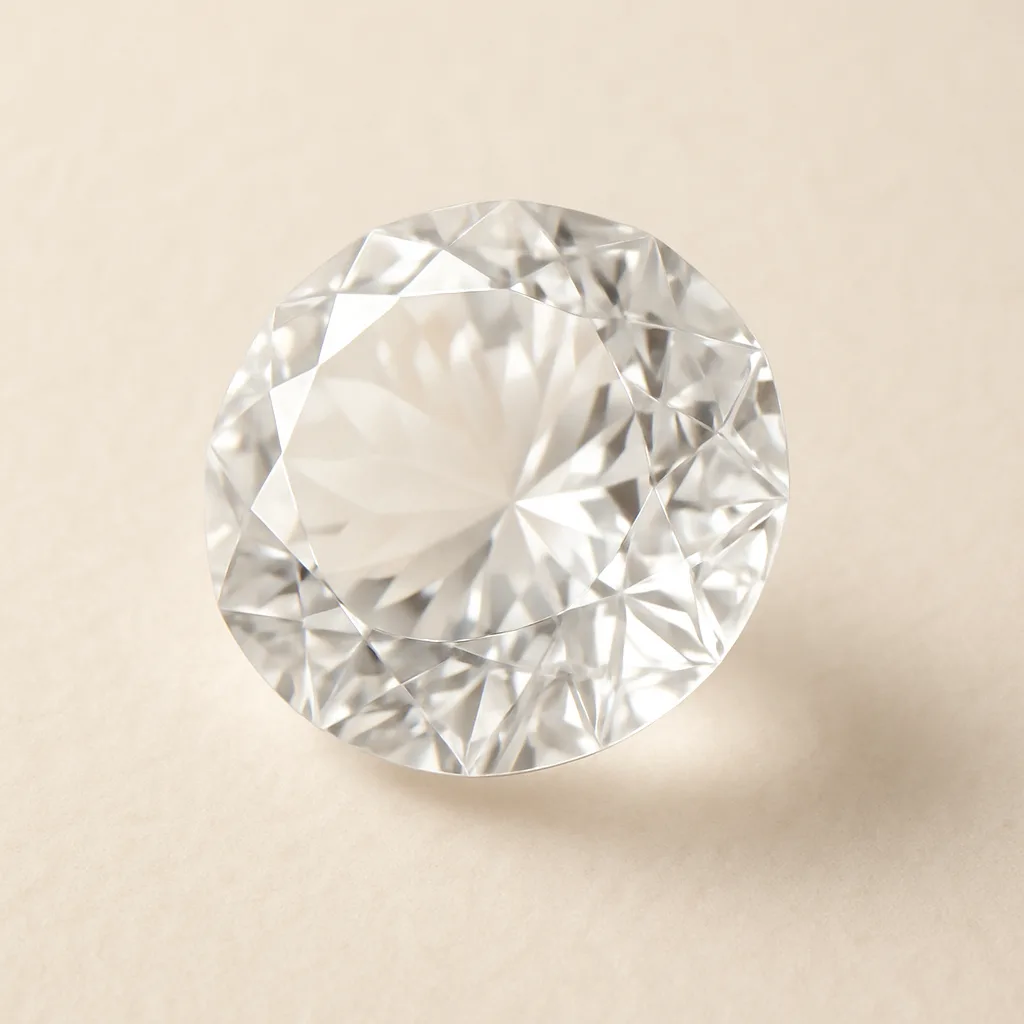
Pure water-clear colorless, sometimes with a faint greenish, yellowish, or grey cast depending on residual iron content in the silica feedstock. Highest-grade Swarovski 'Crystal Aurora Borealis' and 'Crystal Vitrail' coated finishes produce iridescent multicolor flashes from thin-film metal-oxide coatings (1908 patent, post-1955 Christian Dior partnership). Cerium-oxide-decolorized batches produce the cleanest near-water-clear material.
- Regular round gas bubbles distributed evenly through the matrix — diagnostic of pressed or molded glass at 10×
- Surface molding seams and press-die parting lines on backs
- Devitrification crystallites in older or heat-stressed material
- Foreign particles (refractory grains, undissolved feedstock) in lower-grade batches
- Lampwork beads: spiral flow lines from molten-glass winding
- Singly refractive (amorphous glass structure) — no at any orientation
- Refractive index 1.50–1.70 depending on lead content (Swarovski Crystal at ~32 wt% PbO reads RI 1.63–1.65)
- Specific gravity 2.4–4.5 — lead-crystal at 2.85–4.50, soda-lime at 2.40–2.55
- Mohs 5–6 — easily scratched by quartz (Mohs 7)
- Conchoidal fracture — diagnostic of amorphous materials
- 0.010–0.025 depending on lead content — never approaches diamond's 0.044 or CZ's 0.058
- 01Regular round gas bubbles visible at 10× — immediately diagnose pressed or molded glass; rock crystal and diamond never show this signature
- 02Singly refractive (no ) versus rock crystal's clear at 30× immersion through the table
- 03Refractometer reads 1.50–1.70 versus rock crystal 1.544–1.553 (overlapping but diagnostic combined with polariscope) or diamond 2.417
- 04Mohs 5–6 scratches against a steel knife (Mohs 5.5+); rock crystal (Mohs 7) and diamond (Mohs 10) are unaffected
- 05Specific gravity 2.4–4.5 versus rock crystal 2.65 (overlap) versus diamond 3.51 — combined with refractometer for diagnostic separation
- 06 0.010–0.025 versus diamond 0.044 — visible 'fire' (rainbow flashes) noticeably weaker in glass than in diamond
- Mohs 5–6 — stores separately to avoid scratches
- Avoid ultrasonic cleaning — vibration can crack the brittle matrix
- Stable to light and mild detergent; warm soapy water and soft brush
- Avoid thermal shock — conchoidal fracture risk
- Avoid strong acids and bases — surface etching possible on lead-crystal
- Swarovski Aurora Borealis and Vitrail coatings can be damaged by abrasion — handle gently
Modern molded and faceted clear-glass cabochons trade at $0.05–$0.50 per piece wholesale (Indian and Chinese mass production); Swarovski Crystal AB and Crystal Vitrail components at $0.50–$5 per piece (wholesale); Preciosa and Asfour Crystal components at $0.30–$3 per piece. Genuine eighteenth- and nineteenth-century clear paste (Strass-tradition French, Ravenscroft-tradition English) trades at $150–$5,000 per piece at vintage and estate auctions; museum-quality royal-attribution pieces can reach $50,000–$500,000.
Note: Disclosure as 'glass' or 'crystal' (the latter requires minimum 24 wt% PbO under EU Directive 69/493/EEC and US FTC rules) is mandatory; the trade name 'Swarovski Crystal' is a registered trademark and must be used only for genuine Swarovski components. Beware of clear glass marketed as 'genuine crystal' without the minimum lead content — true lead-crystal commands a premium for its high refractive index and bright sparkle. The closure of Swarovski's North American production facilities in 2020 and the company's strategic shift toward lab-grown gemstones has created a vintage-Swarovski collector market with documented pre-2020 components commanding 30–50% premiums over current production. The Czech Preciosa and Egyptian Asfour brands provide competitive pricing at retail levels.
Clear glass is amorphous SiO₂-based paste in its uncolored form — the foundational substrate from which all colored paste glasses are derived. Soda-lime base composition (Na₂O–CaO–SiO₂ typically 14:14:72 wt%) produces RI 1.50–1.52 and SG 2.40–2.55 (the standard commercial 'window glass' formulation); potash-lime base (K₂O substituting for Na₂O) yields slightly higher RI 1.52–1.55 and was the basis of Bohemian crystal; lead-crystal formulations (24–35 wt% PbO replacing CaO and partial SiO₂, Ravenscroft 1674 patent) yield RI 1.55–1.70 and SG 2.85–4.50, with bright sparkle and high approximating natural gem brilliance. Mohs 5–6, singly refractive, conchoidal fracture. Industrial production is dominated by Bohemian Gablonzer (Jablonec nad Nisou, Czech Republic), Swarovski (Wattens, Tyrol, Austria, 1892–present), Preciosa (Jablonec nad Nisou, 1948–present), and Asfour Crystal (Cairo, Egypt, 1961–present), with twentieth- and twenty-first-century mass production also from Chinese (Pujiang, Zhejiang) and Indian (Firozabad) factories.
Origins
aceted gems at scale. Italy (Murano, Venice) supplies high-grade lampwork beads and the Czech-influenced Murano cristallo lineage. France (Saint-Gobain, Baccarat) produced eighteenth- and nineteenth-century Strass paste and Baccarat crystal. England (Stourbridge, West Midlands, and Bristol, Avon) produced Ravenscroft-tradition lead crystal and English-cut paste. India (Firozabad) and China (Pujiang, Zhejiang) dominate twenty-first-century mass production.
History
Roman colorless glass appears at Pompeii from the first century CE; Pliny's Naturalis Historia Book 36 (c. 77 CE) describes the manufacture of 'glass that is invisible' (cristallo-precursor cerium-decolorized batches). The Venetian Murano tradition (Angelo Barovier's 1450s cristallo breakthrough) established the medieval European leaded-glass production that would dominate luxury glassware for three centuries. George Ravenscroft (1632–1683), an English merchant turned glassmaker, secured the 1674 patent for lead-crystal glass at his Henley-on-Thames workshop, using lead oxide (litharge, PbO) at 24–35 wt% to produce a brilliant, easily cut crystal that broke the Venetian monopoly on luxury glass. Georg Friedrich Strass (1701–1773), a Strasbourg-born Parisian jeweller, perfected leaded-paste imitation gemstones in the 1730s and was named jeweller to King Louis XV in 1734; 'Strass paste' became the standard high-quality glass-imitation material, and the word 'rhinestone' (originally from quartz pebbles collected along the Rhine in Alsace) was redirected to mean Strass-style paste. Daniel Swarovski (1862–1956), a Bohemian-born Austrian glass-cutter, patented an electric crystal-cutting machine in 1892 and founded his Wattens (Tyrol) factory the same year; the resulting precision-cut, calibrated-sized crystal components revolutionized costume jewelry from the Edwardian period forward. The 1908 Aurora Borealis iridescent coating (later partnered with Christian Dior's 1955 New Look) extended the brand's reach. Preciosa (founded 1948 in Jablonec nad Nisou under Czech state direction) and Asfour Crystal (founded 1961 in Cairo) provided global competition through the late twentieth century. The 1968 US FTC Jewelry Guides §23.25 disclosure rules required explicit 'glass' or 'imitation' labeling.
Lore & symbolism
No birthstone designation (synthetic/imitation material). The Venetian cristallo tradition carries the strong cultural associations of Renaissance luxury and the medieval pilgrim-trade in rock-crystal reliquaries and Marian devotional objects. The Bohemian Gablonzer regional craft tradition is preserved under UNESCO intangible cultural heritage; the Swarovski Crystal Worlds (Kristallwelten) attraction at Wattens, opened in 1995 for the company's centenary, hosts approximately 800,000 visitors annually. Modern crystal-writing assigns no specific spiritual properties to glass imitations, though contemporary minimalist and bridal jewelry segments lean heavily on Swarovski Crystal Aurora Borealis and Crystal Vitrail finishes for their brilliance.
Tools to confirm this stone
Tools that help confirm Clear Glass. Tap any item to jump to the matching section on the gem tools page.
- 最終確認日
- 2026年4月28日
- 参 考 文 献
- Gem Encyclopedia/ GIA (Gemological Institute of America)
- 宝石鑑別基準/ 中央宝石研究所 (CGL)
- Mineral & Gem Database/ Mindat.org / Gemdat.org
- 宝石学入門/ 全国宝石学協会
本ページの物性値(屈折率・比重・硬度・結晶系等)は、上記の権威ある一次資料を相互参照して編集しています。最新の鑑別研究の進展により値が更新される場合があります。