identified this stone yet
Charoite
| Hardness | 5-6 |
| Specific gravity | 2.54-2.58 |
| Refractive index | 1.550-1.559 |
| Crystal system | 単斜晶系 |
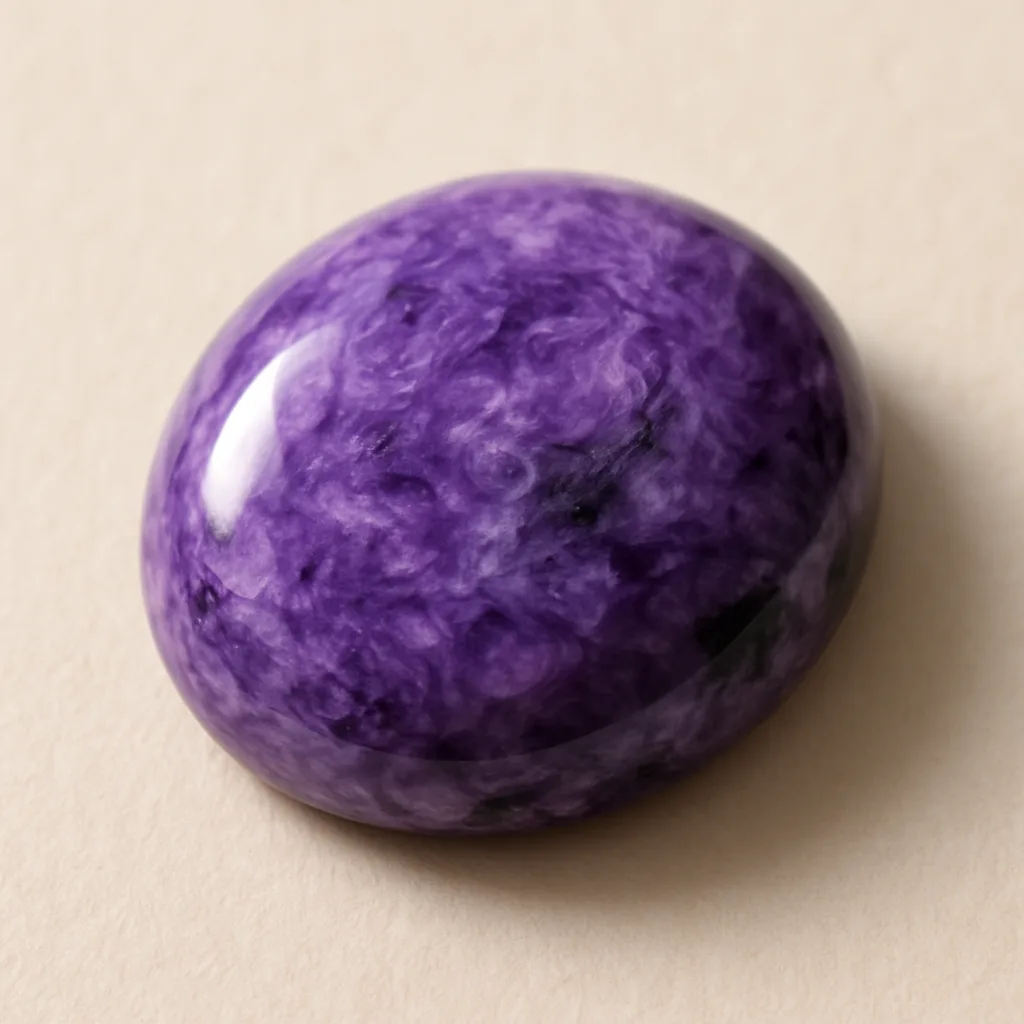
Lavender, lilac, plum-purple, and violet — never uniform, always swirled with the chatoyant fibers of the host aggregate. Manganese is the principal chromophore.
- Black aegirine fibers — a major accessory mineral, contributes texture
- Tinaksite and canasite (orange to yellow) — sometimes visible as small patches
- Microcline (white) — softens the overall purple tone where present
- Pyrite and chalcopyrite specks in some material
- Polycrystalline aggregate — no single-crystal optical figure
- Doubly refractive (monoclinic component)
- Refractive index 1.55–1.57 — measured as a spot reading on surfaces
- Specific gravity 2.54–2.78 — variable depending on aegirine and microcline content
- abochons
- 01Interlocking fibrous chatoyant texture at 10× is diagnostic and unmistakable
- 02Specific gravity 2.55–2.78 separates from dyed agate (2.60) and dyed howlite (2.58) by texture rather than density — the fibrous structure is decisive
- 03Refractive index spot 1.55 separates from sugilite (1.59–1.61) and from sodalite (1.48)
- 04The Murun-only provenance is itself a strong indicator — any slab marketed as charoite from another locality is misidentified
- Mohs 5–6 — softer than most gem materials, suitable for pendants and earrings rather than rings
- Avoid ultrasonic and steam cleaning — the polycrystalline structure can develop micro-fractures
- Stable to light; protect from sharp blows and from harsh chemicals
A few thousand yen per cabochon for ordinary material up to several tens of thousands of yen per cabochon for top-grade Murun material with deep violet color and dramatic chatoyant swirls.
Note: No treatments are recognized for charoite — the stone is sold as polished cabochons, slabs, and beads with the natural swirling pattern. Material with strong violet color and clear feathered patterns commands a premium; uniform color is generally less desirable than dramatic swirling. Imitations made of dyed agate or dyed howlite occasionally appear in low-end markets and are identified by the absence of the characteristic fibrous structure under 10× magnification.
Charoite is a complex potassium-calcium-sodium silicate — K(Ca,Na)₂Si₄O₁₀(OH,F)·H₂O is the simplified formula, though the mineral is structurally a chain silicate of unusual complexity — that forms a fibrous, interlocking polycrystalline aggregate with an unmistakable swirling lilac-to-deep-purple appearance. The species is monomineralic in name only — every commercial slab is a rock composed of charoite intergrown with subordinate aegirine, tinaksite, microcline, and canasite, and the value of a depends on the proportion and pattern of these accessory phases. The Murun massif at the headwaters of the Chara River in the Sakha Republic (eastern Siberia) is the only commercial source on earth, and Soviet-era export restrictions kept the material almost invisible to the Western market until the 1990s.
Origins
The Murun massif in the Aldan Shield of Sakha-Yakutia, near the headwaters of the Chara River in eastern Siberia, is the only commercial source on earth. Discovery dates to the late 1940s, when Soviet geologists working on the Chara-Tokko regional survey logged unusual purple rocks; serious mining began in the 1960s under the Soviet ministry of geology, and the material was first marketed inside the USSR through Yakutian state-run lapidary shops. The mine is in extremely remote terrain and is worked seasonally — the limited production keeps charoite in the rare-and-collectible category despite the relatively low per-carat price.
History
Charoite was formally described as a distinct mineral species by Yuri Gavrilovich Rogov, Vera Pavlovna Rogova, and colleagues in 1978 — they coined the name from the Russian chary ('charms' or 'magic'), a play on the locality name Chara River. The IMA accepted the name and species in 1978. Until the dissolution of the Soviet Union in 1991, virtually all material moved through state channels and was rarely seen in Western markets; the 1990s liberalization of Russian gem exports brought charoite into mainstream Western lapidary use, and Tucson 1994 was the first major international showing.
Lore & symbolism
Charoite has no classical or birthstone tradition — its lore is entirely New Age 20th-century, with claims of spiritual transformation, kundalini activation, and 'soul healing' that emerged in Western metaphysical circles after the stone's Western introduction in the 1990s. The Russian name itself is a play on 'magic,' which lends a marketing-friendly etymology to the modern claims.
Tools to confirm this stone
Tools that help confirm Charoite. Tap any item to jump to the matching section on the gem tools page.
- Last reviewed
- April 28, 2026
- Bibliography
- Gem Encyclopedia / GIA (Gemological Institute of America)
- Gem Identification Standards / Central Gem Laboratory (CGL), Tokyo
- Mineral & Gem Database / Mindat.org / Gemdat.org
- Introduction to Gemology / Gemmological Association of All Japan (GAAJ)
The gemological data on this page (refractive index, specific gravity, hardness, crystal system, etc.) is cross-checked against the authoritative primary sources listed above. Values may be revised as gemological research advances.