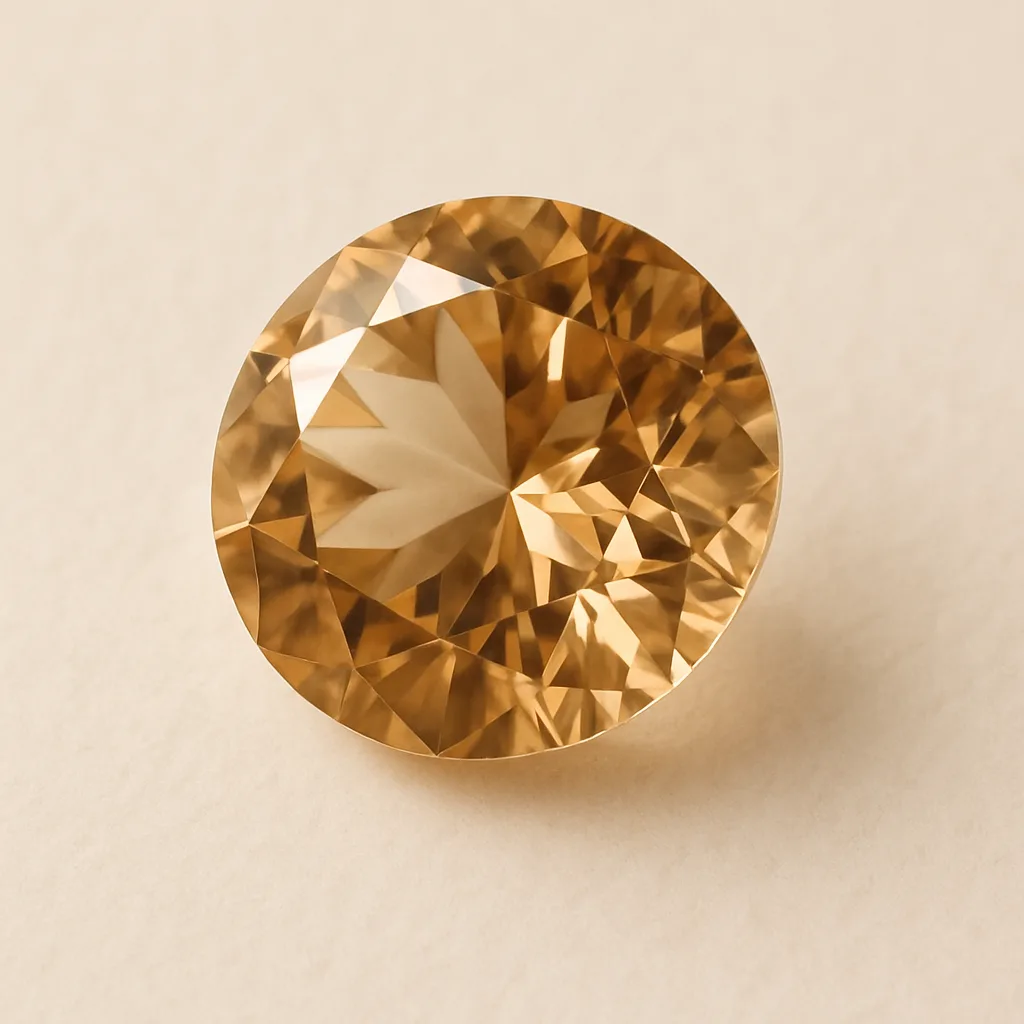
identified this stone yet
Champagne Topaz
| Hardness | 8 |
| Specific gravity | 3.50 |
| Refractive index | 1.619-1.627 |
| Crystal system | 斜方晶系 |
Pale sherry-cognac through warm cocoa brown to deep cognac amber. The most prized tones are saturated warm brown with golden undertones, free of grey or olive modifiers, especially in stones above 5 carats with high transparency.
- nclusions, elongated parallel to the c-axis
- Healed fractures with fluid-filled tubes
- Color zoning along the c-axis — pale and saturated brown bands
- Pre-existing planes visible under 10×
- Doubly refractive (biaxial positive)
- 0.008–0.010 — moderate visible at 10×
- Moderate dichroism — brown and pale yellowish-brown along different optical directions
- Perfect basal — diagnostic of topaz
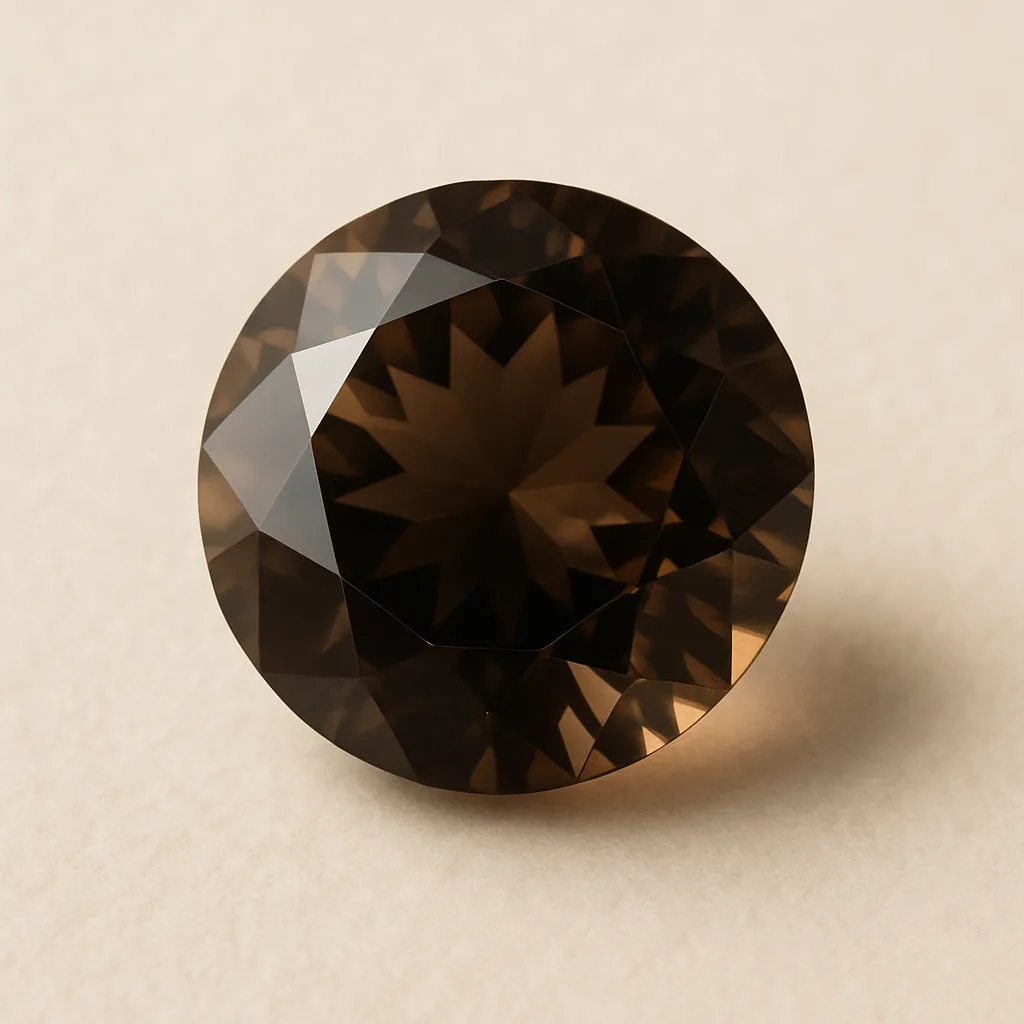
- 01SG 3.50–3.57 — feels noticeably heavy in hand compared with smoky quartz (SG 2.65) at equal size
- 02RI 1.610–1.638 — clearly higher than smoky quartz (1.544)
- 03 visible under 10× as a flat reflective plane perpendicular to the c-axis
- 04Hand-weight test against smoky quartz is the single fastest field test
- Mohs 8 with perfect basal — avoid sharp impacts along the c-axis
- Never use ultrasonic or steam cleaning; warm soapy water with a soft brush only
- Avoid sudden thermal shock to prevent propagation
- Stable to light and normal cleaning chemicals
Roughly $15–$50/ct for commercial faceted champagne topaz under 3 ct, $60–$200/ct for clean stones in the 5–10 ct range with rich cognac-brown body, and $250–$800/ct for exceptional large stones (20+ ct) with vivid champagne saturation and high transparency.
Note: Heat treatment is uncommon for champagne topaz (the warm brown is generally the desired natural color) but exists at the lower end of the market when sellers want to deepen pale material. The main market complication is the persistent abuse of 'smoky topaz' as a misnomer for smoky quartz — a fast hand-weight comparison reveals the fraud (quartz is 25% lighter at equal size). Disclosure of treatment is expected for fine stones above $200/ct.
Champagne topaz is Al₂SiO₄(F,OH)₂ tinted by a combination of chromium and crystal-lattice color centers producing warm brown body color. There is no sharp gemological boundary between sherry-gold yellow topaz, champagne topaz, and the imperial topaz pink-orange range — the trade names describe overlapping color zones along the same chromium-and-defect color axis. Mohs 8 and SG 3.50 distinguish champagne topaz from the much lighter and softer smoky quartz, which is sometimes deceptively marketed as 'smoky topaz' in lower-tier markets despite being unrelated mineralogically.
Origins
Brazil's Ouro Preto district in Minas Gerais is the dominant commercial source for champagne topaz, producing material that grades continuously from sherry yellow through champagne brown into pinkish-imperial tones. Sri Lanka, Pakistan's Gilgit, Nigeria, Russia's Ural Mountains, and Mexico's San Luis Potosí contribute additional production. The Utah Topaz Mountain deposits yield characteristic sherry-to-colorless crystals whose color partially fades upon prolonged exposure to sunlight after mining — a quirk that makes the original sherry color a 'collector's clock' rather than a permanent feature.
History
Brown topaz was historically considered a less desirable color in the European jewelry trade — most was either left as collector specimens or heat-treated toward yellow or pink in the 19th and early 20th centuries. The 'champagne topaz' trade name emerged in the 1970s and 1980s as part of a broader marketing trend that rebranded brown-toned gemstones into more appealing names (champagne diamond, cognac diamond, chocolate diamond, smoky champagne quartz). The marketing repositioning succeeded, and champagne topaz now appears regularly in modern bridal and fashion jewelry as a warm, gender-neutral alternative to colorless and yellow stones.
Lore & symbolism
aceted before the 20th century.
Tools to confirm this stone
Tools that help confirm Champagne Topaz. Tap any item to jump to the matching section on the gem tools page.
- 最終確認日
- 2026年4月28日
- 参 考 文 献
- Gem Encyclopedia/ GIA (Gemological Institute of America)
- 宝石鑑別基準/ 中央宝石研究所 (CGL)
- Mineral & Gem Database/ Mindat.org / Gemdat.org
- 宝石学入門/ 全国宝石学協会
本ページの物性値(屈折率・比重・硬度・結晶系等)は、上記の権威ある一次資料を相互参照して編集しています。最新の鑑別研究の進展により値が更新される場合があります。