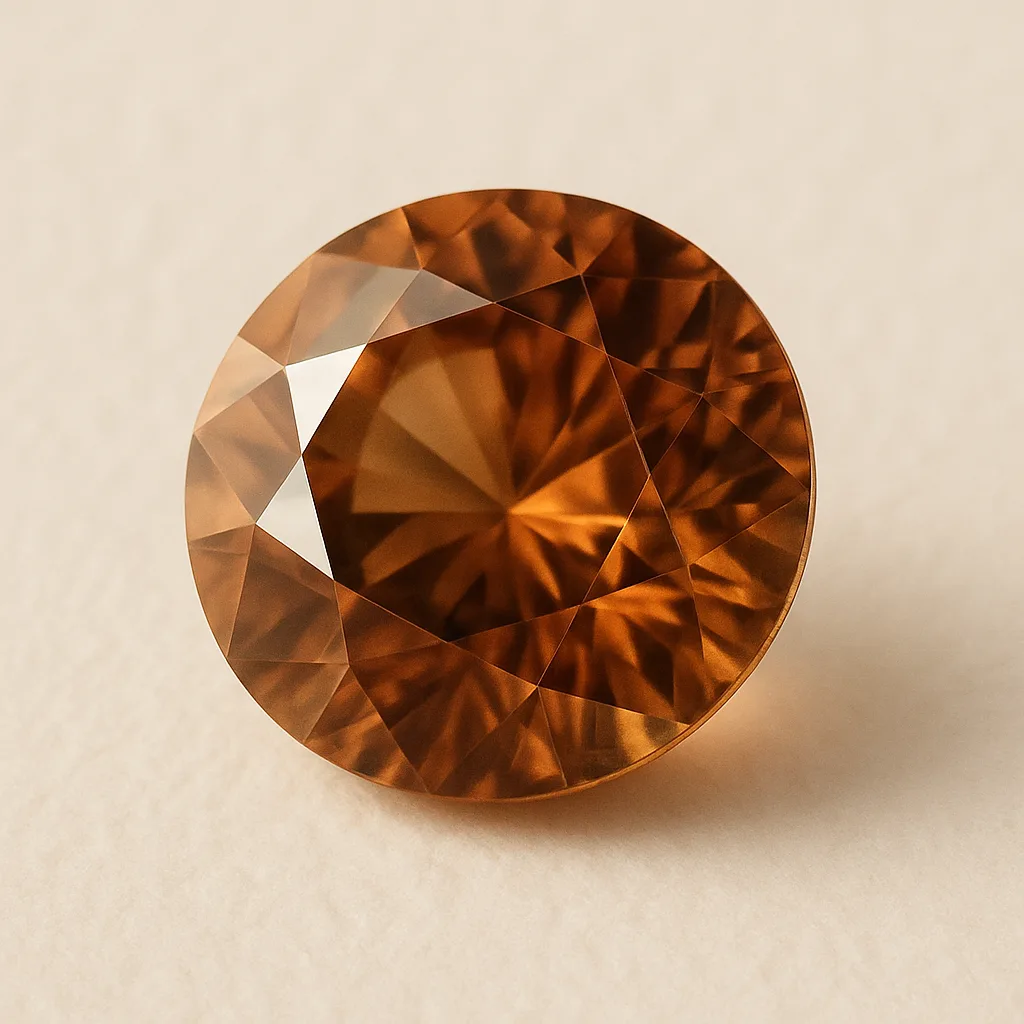
identified this stone yet
Brown Zircon
| Hardness | 7-7.5 |
| Specific gravity | 4.60-4.70 |
| Refractive index | 1.925-1.984 |
| Crystal system | 正方晶系 |
Amber, golden brown, reddish brown ('cinnamon'), deep brown, and occasional smoky brown — the standard tones for unheated Cambodian and Sri Lankan material. Most brown rough is heat-treated to colorless or blue and not retained in its original color.
- Strong visible at 10× — the diagnostic optical feature of zircon
- nclusions (mostly seen in older material)
- nclusions
- Color zoning along crystallographic axes
- Occasional 'paper-edge' abrasion of junctions on worn stones (zircon is brittle despite Mohs 7–7.5)
- Doubly refractive, uniaxial positive
- Refractive index 1.81–1.984 (high zircon) ranging down to 1.78–1.82 (low / metamict zircon)
- 0.039–0.059 — produces pronounced visible at 10×
- Specific gravity 4.0–4.7 (varies with metamictization — high zircon 4.6–4.7, low zircon 3.9–4.1)
- Strong (0.039) — high zircon shows fire comparable to diamond
- 01Visible at 10× — the single most diagnostic feature of zircon, immediately separating it from sapphire (small ), topaz, and quartz
- 02Refractive index 1.81–1.984 — well above any sapphire, topaz, or smoky quartz; over-the-limit on standard refractometers
- 03Specific gravity 4.0–4.7 — distinctively heavy in the hand, much heavier than smoky quartz (2.65) and topaz (3.49–3.57)
- 04Strong (0.039) — produces visible fire approaching diamond, far stronger than competing brown stones
- 05'Paper-edge' abrasion on older worn stones is a common indicator of zircon (brittleness despite hardness)
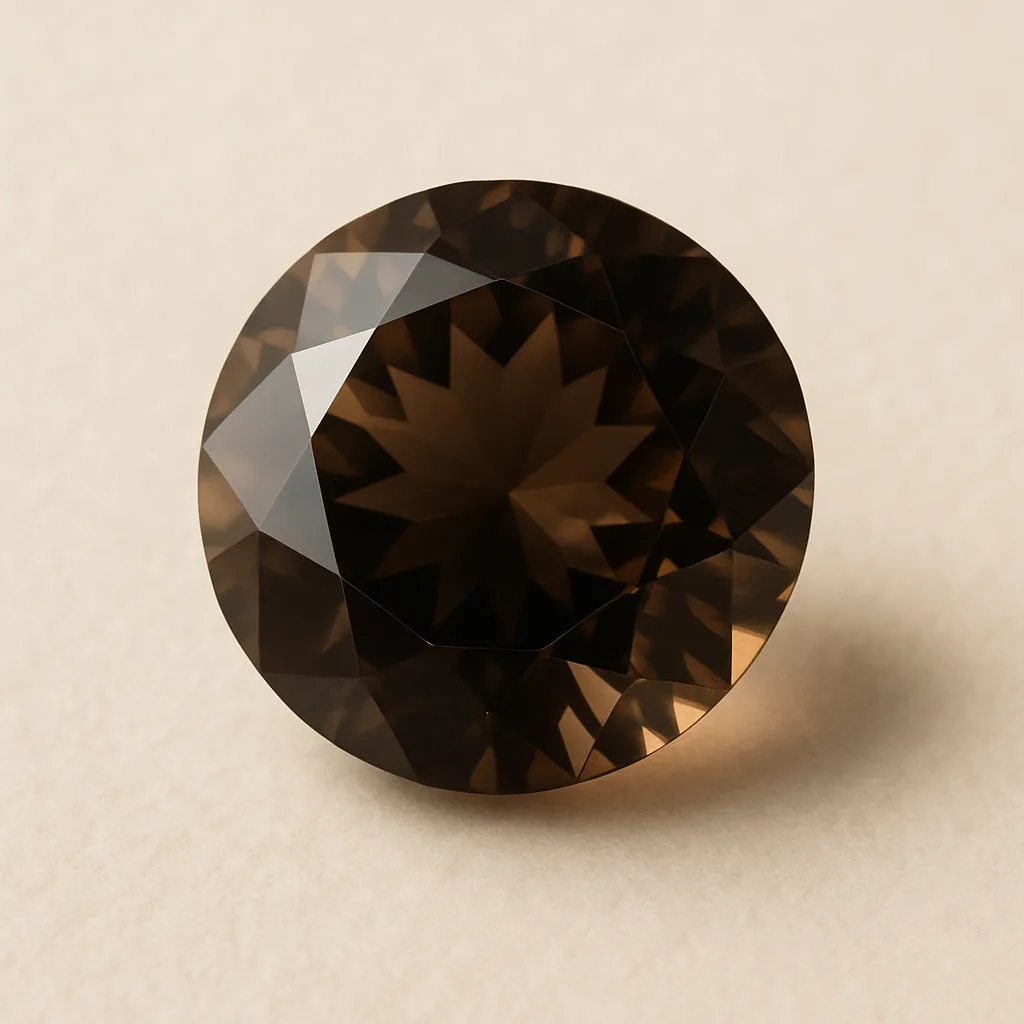
- acet-edge chipping; store separately from other gems
- Avoid prolonged direct sunlight — some heat-treated zircon (particularly blue Starlite) can fade or revert color; brown zircon is more stable but not entirely immune
- Generally safe to warm soapy water; ultrasonic and steam are acceptable for crystalline high zircon but should be avoided for metamict (low) zircon, which is more fragile
- Avoid hard knocks at junctions — the brittle behavior is the chief wear issue
$20–80/ct for commercial unheated brown zircon below 3 ct; $100–300/ct for fine cinnamon-tone Cambodian or Sri Lankan stones above 3 ct; large clean unheated browns above 10 ct are scarce and trade by negotiation rather than at standard wholesale rates.
Note: The dominant fact of the brown zircon market is that most of it does not stay brown — Cambodian and Sri Lankan brown rough is bulk-fired in reducing atmospheres (typically charcoal or hydrogen-rich kilns at 800–1000 °C) and emerges as colorless or blue 'Starlite' material for the commercial trade. The traditional 'hyacinth' brown-to-orange-brown zircon market has been substantially squeezed by this conversion economy, and fine unheated brown zircon above 3–5 ct in saturated cinnamon tones is sometimes harder to obtain than equivalent blue heated material. Disclosure of heat treatment is standard in the trade but not always communicated to consumers. Metamict (low) zircon should be handled carefully because its reduced density and crystalline disorder make it more brittle than high zircon.
Brown zircon is zirconium silicate (ZrSiO₄), tetragonal, in which the brown coloration derives partly from radiation-damaged metamict states and partly from trace iron and uranium associated with the radioactive thorium and uranium decay that affects all zircon to varying degrees. Mohs 7–7.5, SG 4.0–4.7 (high zircon — undamaged — runs 4.6–4.7; low zircon, fully metamict, runs around 3.9–4.1), RI 1.81–1.984, with the high (0.039–0.059) producing pronounced visible at 10× — the single most distinctive optical signature of zircon. Anderson's 1947 classification distinguishes high zircon (fully crystalline, high RI, sharp dichroism), medium zircon (partially metamict), and low zircon (fully metamict, amorphous, RI 1.78–1.82, density reduced) — most Cambodian brown zircon falls in the high or medium ranges. Brown zircon shows distinctive 'paper edges' or abrasion on worn stones because zircon, despite its hardness, is somewhat brittle.
Origins
acetable material. Madagascar (Tulear and Ilakaka) produces brown zircon as a heavy-mineral concentrate accessory to its main sapphire output.
History
Zircon's commercial history is among the oldest of any gem species. The Sanskrit Ratnapariksha gem-treatise (c. 6th century CE) names zircon as 'jargoon' (Persian zar-gun, 'gold-colored'), a term that survives in English as the historic synonym for yellow-brown zircon. Pliny the Elder describes 'hyacinthus' — yellow-orange zircon — as the eleventh foundation stone of the New Jerusalem in his discussion of biblical mineralogy (Naturalis Historia 37). The German chemist Martin Heinrich Klaproth isolated the element zirconium from Sri Lankan brown zircon in 1789, giving the element its name (from the Persian zar-gun via the species name). Throughout the 18th and 19th centuries, brown zircon from Sri Lanka and India was traded under the 'hyacinth' and 'jacinth' trade names — terms that also covered yellow-orange zircon and sometimes orange-red garnet, creating persistent confusion in the historical jewelry record. The Hungarian Holy Crown of St. Stephen (assembled c. 11th–12th century) contains hyacinth stones, which modern gemological analysis has identified as zircon rather than garnet. The 1920s development of reducing-atmosphere for Cambodian zircon — which produces the brilliant blue 'Starlite' marketed by Tiffany & Co. under George Frederick Kunz's stewardship from approximately 1920 — fundamentally restructured the brown zircon market into a starting-material trade rather than a finished-gem trade.
Lore & symbolism
Vedic jyotish gem-tradition assigns zircon (gomed for some traders, hessonite for others — terminology varies by school) to Rahu, the ascending lunar node, with brown and yellow zircon worn for protection against malefic Rahu influence. The Sanskrit Ratnapariksha names jargoon (yellow-brown zircon) among the upagrahas of the gem system — secondary stones suitable for use when the primary gem of a planetary association is unavailable. Pliny's hyacinthus, the orange-red zircon of the Naturalis Historia, was named (according to Pliny himself) for the youth Hyakinthos of Greek mythology, beloved of Apollo, from whose spilled blood the species was said to have sprung. Medieval European lapidary literature (Marbode, Albertus Magnus) credits zircon under its hyacinth name with virtues of sleep induction, plague prevention, and traveler protection — claims of folk-medical tradition without scientific basis but extensive cultural reach.
Tools to confirm this stone
Tools that help confirm Brown Zircon. Tap any item to jump to the matching section on the gem tools page.
- 最終確認日
- 2026年4月28日
- 参 考 文 献
- Gem Encyclopedia/ GIA (Gemological Institute of America)
- 宝石鑑別基準/ 中央宝石研究所 (CGL)
- Mineral & Gem Database/ Mindat.org / Gemdat.org
- 宝石学入門/ 全国宝石学協会
本ページの物性値(屈折率・比重・硬度・結晶系等)は、上記の権威ある一次資料を相互参照して編集しています。最新の鑑別研究の進展により値が更新される場合があります。