identified this stone yet
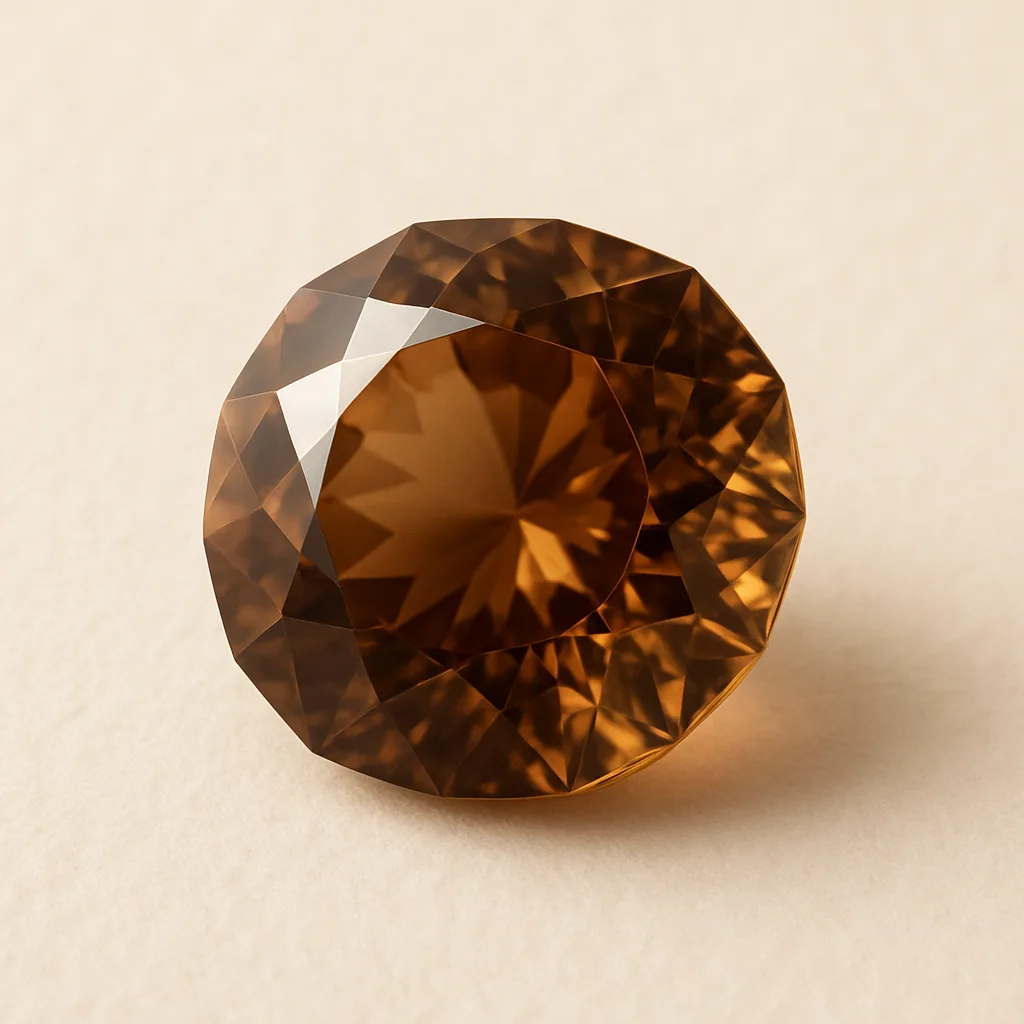
Brown Sapphire
| Hardness | 9 |
| Specific gravity | 4.00 |
| Refractive index | 1.762-1.770 |
| Crystal system | 六方晶系(三方晶系) |
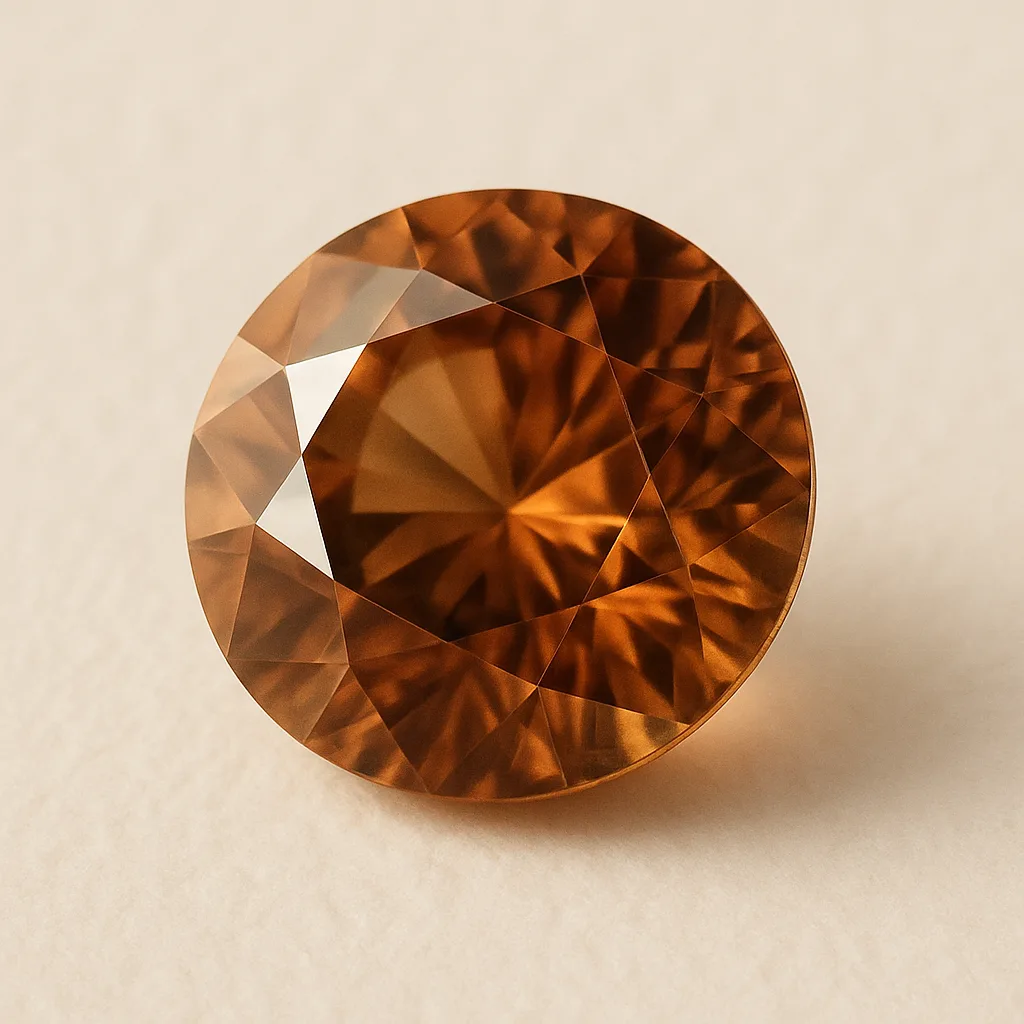
Golden brown, honey brown, reddish brown, coffee brown, and the most prized 'cognac' tone — a saturated reddish-brown with a touch of orange life, neither too dark nor muddy. Strong color zoning is common in unheated stones.
- Silk: short rutile needles in three crystallographic directions, often partially dissolved if heated
- nclusions in healed fractures
- Color zoning in straight bands following hexagonal growth geometry
- nclusions of zircon (sometimes with stress halos), apatite, or magnetite
- Doubly refractive, uniaxial negative
- Refractive index 1.762–1.770
- 0.008–0.009
- Specific gravity 3.95–4.03
- Strong dichroism: yellow-brown and orangey-brown along the two optical directions
- 01Mohs 9 hardness — separates brown sapphire from brown zircon (7–7.5), smoky quartz (7), and brown topaz (8)
- 02Refractive index 1.762–1.770 — much lower than brown zircon (1.81–1.984) and well above smoky quartz (1.54–1.55)
- 03Specific gravity 3.95–4.03 — heavier than smoky quartz (2.65) and topaz (3.49–3.57), lighter than brown zircon (4.0–4.7)
- 04Strong dichroism visible through a dichroscope rules out singly refractive imitations (garnet, glass)
- 05Natural silk or hexagonal color zoning supports natural origin; indicate Verneuil synthetic
- Mohs 9 — exceptionally durable; safe for daily wear, ultrasonic, and steam cleaning unless fracture-filled
- Heat-treated stones are stable to normal jewelry conditions; beryllium-diffused stones are stable but disclosure is required
- Avoid prolonged contact with hydrofluoric acid (a corundum solvent at high temperature)
From $30–150/ct for commercial heated Madagascar or Thai brown sapphire, up to $1,500–4,000/ct for fine unheated Montana or Anakie cognac stones above 2 ct. The fancy-color sapphire market is still maturing and prices vary substantially between dealers.
Note: Most commercial brown sapphire is heat-treated to deepen or stabilize color, and a portion of marketed 'yellow sapphire' began as heat-shifted brown material — disclosure practice in this segment is uneven. Beryllium diffusion can be applied to brown stones to produce orange and padparadscha-adjacent colors, and any high-value brown or cognac-tone stone above 2 ct should be accompanied by a lab report from GIA, GRS, or AGL specifying treatment status. Unheated brown sapphire from Montana or unheated cognac from Anakie commands a premium in the modern fancy-color market.
Brown sapphire is corundum (Al₂O₃) in which Fe³⁺ is the dominant chromophore, with secondary Fe²⁺-Ti⁴⁺ charge transfer contributing varying degrees of warmth. Mohs 9, SG 3.95–4.03, RI 1.762–1.770, doubly refractive (uniaxial negative). Tones range from warm golden brown through reddish brown ('cognac') to deep coffee brown, often with strong dichroism that splits into yellow-brown and orangey-brown along the two optical directions. The Australian Anakie field, the Thai-Cambodian border belt, Madagascar's Ilakaka, Montana's Yogo Gulch (rare browns), and Sri Lankan Ratnapura are the principal modern sources.
Origins
Anakie, in Central Queensland, is the historical heart of brown sapphire production — sapphire was first found there in 1875, and from the 1880s through the mid-20th century the Sapphire-Rubyvale-Anakie gemfields produced enormous tonnages of brown, yellow, and green sapphire that mostly went to abrasive use. Thailand's Chanthaburi and Bo Phloi districts have produced brown sapphire continuously since the 19th century, with the modern heat-treatment industry centered at Chanthaburi shifting much of this material into yellow and golden tones. Madagascar's Ilakaka (post-1998) supplies bright modern browns, while Montana's Yogo Gulch yields rare brown specimens prized for their unheated provenance. Sri Lankan Ratnapura material trends toward lighter, more cinnamon-toned browns.
History
Brown sapphire's commercial history is the inverse of blue sapphire's. From the 1875 Anakie discovery onward — credited to a prospector named Hood who picked up rough at a creek bed on Anakie Station — Queensland brown and green corundum was sorted out as 'industrial grade' and shipped to abrasive manufacturers, with only the rare clean stones cut for gem use. The 20th-century Thai heat-treatment industry, which from the 1960s onward learned to transform pale Ceylon and Madagascar geuda corundum into vivid blue, also developed protocols to lighten dark brown corundum into yellow, golden, and 'champagne' tones — and a substantial fraction of today's so-called yellow sapphire began life as Australian or Thai brown. The 2010s fancy-color sapphire revival, driven by US bridal market shifts away from diamond and by Etsy/Instagram-era marketing of 'earth-tone' engagement rings, finally returned brown sapphire to gem-grade pricing for the first time in over a century.
Lore & symbolism
Brown sapphire carries no significant classical or medieval lore — it was not historically separated from yellow or 'oriental topaz' in pre-modern gem texts. Modern New Age literature, recycling general sapphire associations, positions brown sapphire as the stone of 'grounding,' 'stability,' and 'financial wisdom,' tying its earth tones loosely to root-chakra symbolism. These positionings are entirely contemporary and have no premodern foundation.
Tools to confirm this stone
Tools that help confirm Brown Sapphire. Tap any item to jump to the matching section on the gem tools page.
- 最終確認日
- 2026年4月28日
- 参 考 文 献
- Gem Encyclopedia/ GIA (Gemological Institute of America)
- 宝石鑑別基準/ 中央宝石研究所 (CGL)
- Mineral & Gem Database/ Mindat.org / Gemdat.org
- 宝石学入門/ 全国宝石学協会
本ページの物性値(屈折率・比重・硬度・結晶系等)は、上記の権威ある一次資料を相互参照して編集しています。最新の鑑別研究の進展により値が更新される場合があります。