identified this stone yet
Boulder Opal
| Hardness | 5.5-6 |
| Specific gravity | 2.50-3.20 |
| Refractive index | 1.37-1.47 |
| Crystal system | 非晶質(含水シリカ)+鉄鉱石母岩 |
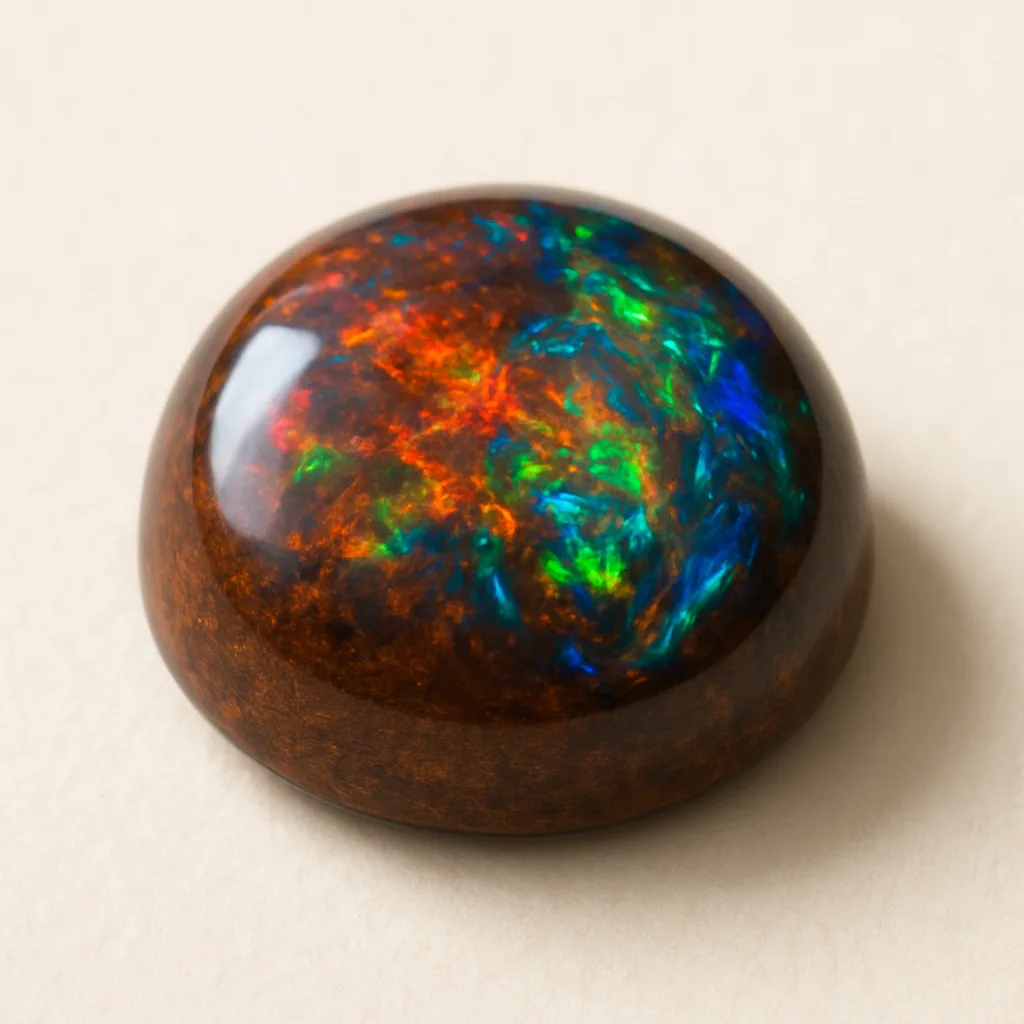
Brown, rusty-red, or grey ironstone matrix carrying veins of opal in every spectral hue. The matrix-to-opal ratio varies widely; some stones are mostly matrix with thin colorful veins, while top stones show broad sheets of play-of-color with only a sliver of ironstone showing.
- Ironstone matrix visible as the natural backing — the diagnostic feature
- Aligned silica spheres responsible for play-of-color (visible only under SEM)
- Iron oxide staining at the opal-matrix boundary
- Occasional sand grains or quartz at the matrix surface
- Amorphous opal seams, singly refractive
- Play-of-color in seam areas; matrix is opaque
- Vitreous to resinous luster on the opal portions
- Strong contrast between matrix and play-of-color enhances perceived saturation
- 01Natural ironstone matrix integrated into the stone, not glued behind it — this distinguishes boulder opal from doublets and triplets
- 02Free-form shape that follows the original seam geometry
- 03Side profile shows continuous transition from opal to matrix rather than a glue line
- 04Queensland origin — boulder opal from anywhere else is essentially unknown in commercial quantity
- Mohs 5.5–6.5 on the opal portions, but matrix provides extra stability
- Avoid sudden temperature changes — opal contains structural water and can craze
- Never use ultrasonic or steam cleaners
- Wipe with a soft cloth; do not soak
Roughly $50–$300/ct for commercial pieces with limited play-of-color, $500–$2,000/ct for clean stones with broad colorful seams, and $5,000–$15,000+/ct for top-grade pieces with red-dominant or harlequin patterns. The largest stones — sometimes over 100 ct — can command six-figure totals when the matrix balance and pattern align.
Note: Boulder opal is essentially untreated, though some material is lightly oiled to deepen contrast — disclosure is variable. Because the matrix is structural, boulder opal is far more impact-resistant than free crystal opal of similar size. Each piece is unique, so prices are set per stone rather than per carat. Yowah nuts and Koroit picture-opal slices are collector subcategories with their own pricing tiers.
Boulder opal is hydrated silica (SiO₂·nH₂O) precipitated in fine cracks, voids, and seams within ferruginous sandstone or 'ironstone' concretions. Because the opal seams are too thin to cut as standalone gems, cutters preserve the dark ironstone behind the opal as a natural background. This produces irregular free-form shapes and gives boulder opal its signature contrast — play-of-color sitting against an earthy host instead of a clean opal body.
Origins
Queensland, Australia is essentially the sole significant source. The main fields stretch through the Winton and Eromanga sedimentary basin: Quilpie, Yowah (famous for the 'Yowah nut,' an ironstone concretion with a central opal kernel), Koroit, Jundah, and Opalton. The Queensland boulder belt was first worked in the 1870s, but it remained a minor curiosity until art-jewelry buyers rediscovered the matrix aesthetic in the 1980s and 1990s.
History
Boulder opal was discovered in Queensland in 1869 at Listowel Downs station near Blackall, with commercial mining at Quilpie following in the 1890s. Through most of the 20th century it was overshadowed by black opal from Lightning Ridge and crystal opal from Coober Pedy. The 1990s saw a revival as artisan jewelers embraced its irregular shapes and matrix character, treating each stone as a one-of-a-kind sculptural element rather than a calibrated gem.
Lore & symbolism
The October birthstone, symbolizing creativity, individuality, and grounding. Boulder opal is sometimes called 'the storyteller's stone' in modern lapidary lore — each piece carries a visible record of the geology it came from. The 14th wedding anniversary gem.
Tools to confirm this stone
Tools that help confirm Boulder Opal. Tap any item to jump to the matching section on the gem tools page.
- 最終確認日
- 2026年4月28日
- 参 考 文 献
- Gem Encyclopedia/ GIA (Gemological Institute of America)
- 宝石鑑別基準/ 中央宝石研究所 (CGL)
- Mineral & Gem Database/ Mindat.org / Gemdat.org
- 宝石学入門/ 全国宝石学協会
本ページの物性値(屈折率・比重・硬度・結晶系等)は、上記の権威ある一次資料を相互参照して編集しています。最新の鑑別研究の進展により値が更新される場合があります。