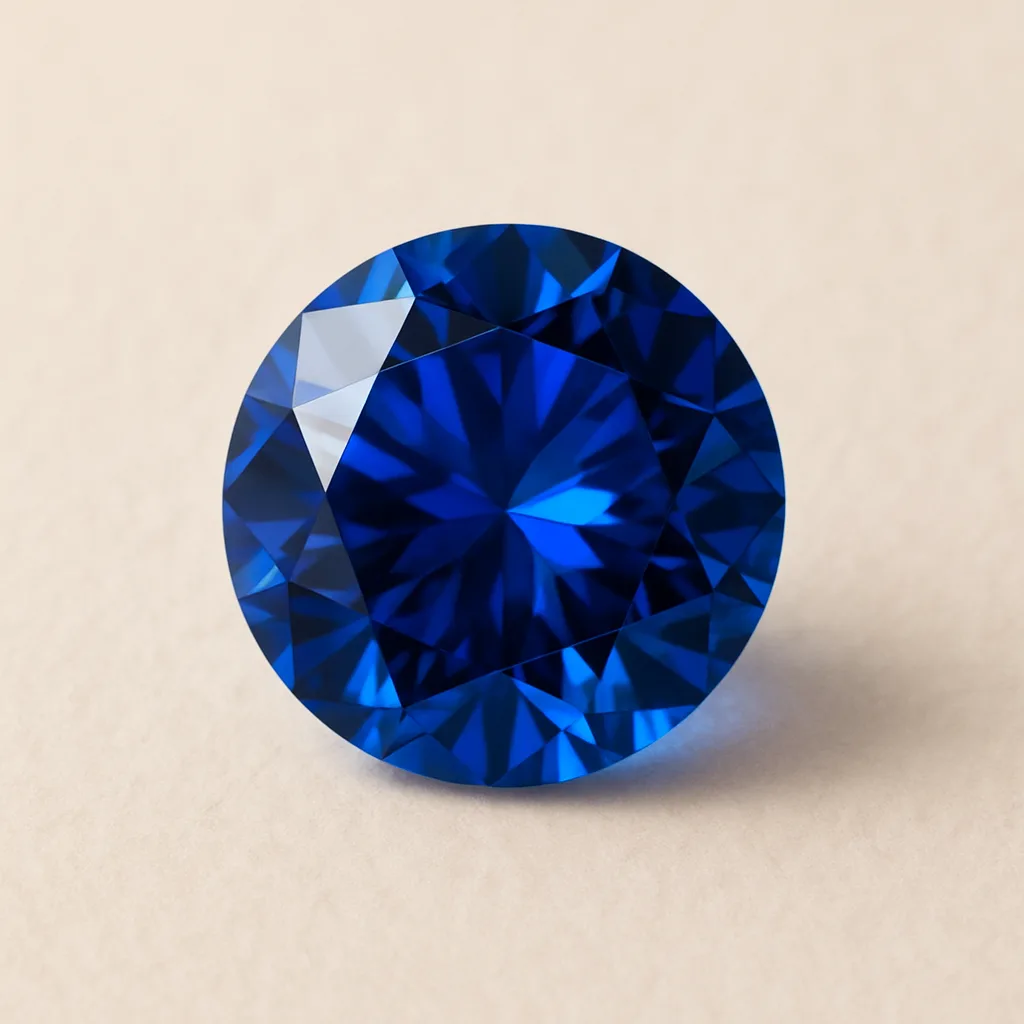
identified this stone yet
Synthetic Blue Spinel
| Hardness | 8 |
| Specific gravity | 3.60 |
| Refractive index | 1.725 |
| Crystal system | 等軸晶系 |
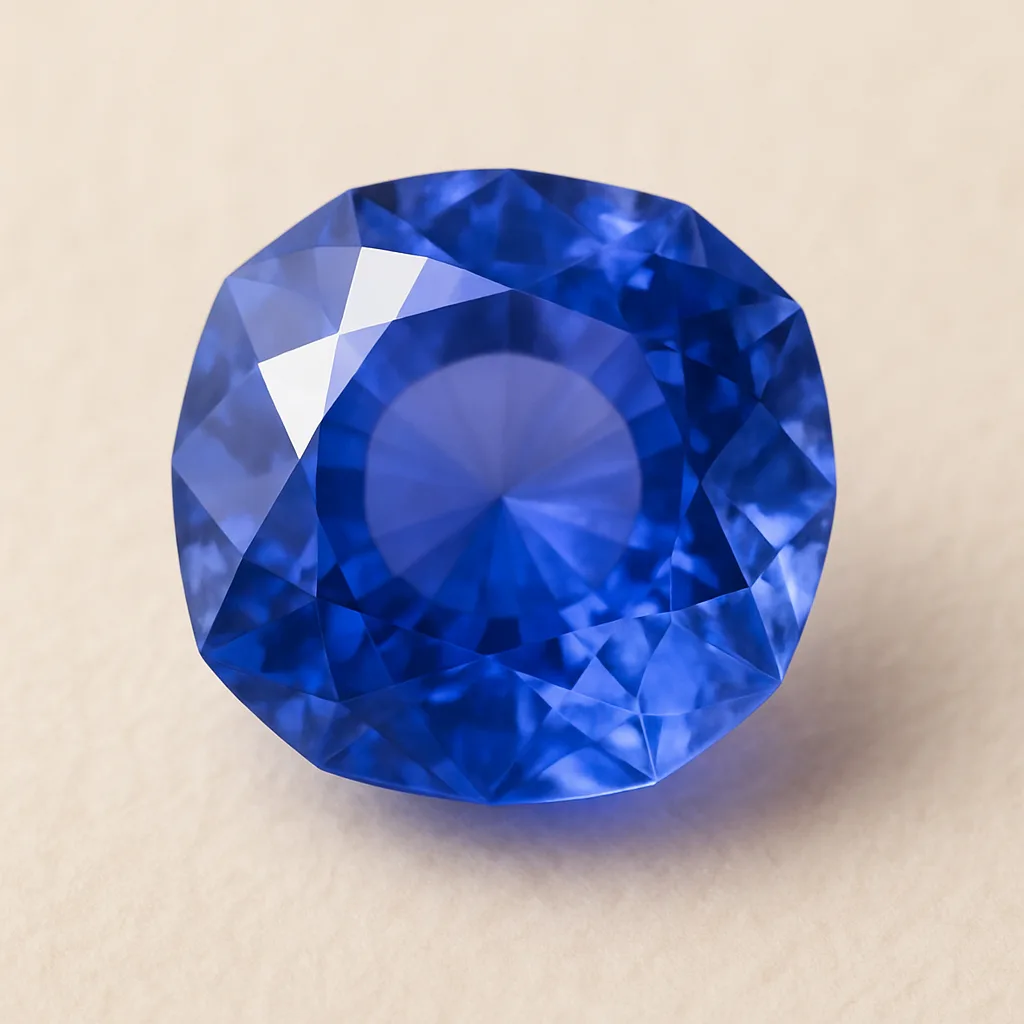
Saturated royal blue, 'London blue,' deep ocean blue, and vivid cornflower blue. Cobalt-doped flame-fusion produces consistently saturated, even color — typically more vivid than natural Sri Lankan or Burmese spinel of equivalent commercial grade, which tends toward grayish or steel blue with iron-dominant chemistry.
- Curved growth striae (Verneuil flame-fusion) — diagnostic at 10× immersion
- Round gas bubbles, sometimes in trails or clusters
- nclusions in some material
- Swirl-like flow patterns in the melt
- Otherwise remarkably clean — much cleaner than natural blue spinel of equivalent grade
- Singly refractive (isotropic cubic) — no
- Refractive index 1.725–1.730
- Vitreous luster
- No (isotropic)
- 01Strong under long-wave UV — the single fastest discriminator from natural blue sapphire (which is essentially inert)
- 02Curved growth striae and round gas bubbles visible at 10× immersion
- 03Single refraction (no ) at the refractometer — separates immediately from sapphire (weakly doubly refractive) and zircon (strongly doubly refractive)
- 04luorescence-tested as a routine precaution
- 05Refractive index 1.725–1.730 is distinctly different from natural spinel (1.715), sapphire (1.760–1.770), and zircon (1.81–1.984)
- Mohs 8 — durable for everyday wear
- Ultrasonic and steam cleaning are safe
- Stable to light and standard cleaning chemicals
- Cobalt color is stable; no heat or radiation sensitivity issues
$2–$15/ct for commercial flame-fusion synthetic blue spinel in standard sizes; rarely above $30/ct for premium Djeva-grade material with selected color. Natural fine cobalt-blue spinel from Vietnamese Luc Yen or Tanzanian Mahenge in clean stones above 1 ct trades at $5,000–$30,000+/ct — a price differential of roughly three orders of magnitude that gives an additional commercial discrimination signal.
Note: The dominant trade fact of synthetic blue spinel is its century-long history as a low-disclosure substitute for natural sapphire and aquamarine. Vintage estate jewelry pre-1996 frequently contains it under various trade names ('synthetic sapphire,' 'synthetic aquamarine,' 'science sapphire,' 'Geneva sapphire,' and occasionally just 'sapphire'). UV-fluorescence testing with a penlight is fast, free, and definitive — anyone considering pre-1990s 'sapphire' jewelry should check fluorescence before paying sapphire prices. Modern disclosed synthetic blue spinel is marketed primarily for class rings, costume jewelry, and inexpensive birthstone pieces.
Synthetic spinel is MgAl₂O₄ (cubic, isotropic) doped with cobalt (Co²⁺) in tetrahedral magnesium sites to produce the deep saturated royal blue. Mohs 8, SG 3.60–3.64 (lower than natural spinel's 3.58–3.61 because commercial flame-fusion melts run slightly aluminum-rich), RI 1.725–1.730 (vs. ~1.715 for natural spinel — a useful refractometer discriminator), no (isotropic cubic). The very strong under long-wave UV is the single most diagnostic feature: natural blue sapphire is iron-blue and substantially inert; flame-fusion cobalt-blue synthetic spinel glows strongly red — a check that takes seconds with a $5 UV penlight. L. Paris established commercial Verneuil spinel synthesis in 1908; saturated cobalt-blue commercial production scaled by 1925 in France, Germany, and Switzerland.
Origins
Switzerland (Djeva, founded 1914 in Monthey by Hrand Djevahirdjian and still operating — the historic premium producer), Germany, France (the original Verneuil and Paris workshops near Paris), Thailand (significant capacity since the 1970s), Russia (multiple Soviet-era and post-Soviet facilities), and China. Thai and Chinese flame-fusion producers dominate modern commercial supply; Djeva remains the historic gem-grade reference.
History
Auguste Verneuil announced his flame-fusion process for ruby at the French Academy of Sciences in 1902, and his colleague L. Paris adapted the process to spinel by 1908 — using magnesium oxide and aluminum oxide feedstock in stoichiometric ratio rather than pure alumina. By the mid-1920s, cobalt-doped blue spinel was a standard commercial product, used as a 'synthetic sapphire' or 'synthetic aquamarine' in Art Deco-era jewelry; the choice of trade name was a commercial decision rather than gemological honesty. The American costume jewelry industry of the 1940s–1960s — Coro, Trifari, Eisenberg, Boucher, Schreiner, Hobé, Sandor — relied heavily on synthetic blue spinel as an inexpensive blue stone, set in 'sterling' or 'vermeil' mountings and marketed without explicit synthetic disclosure in many lines. The 1957 FTC Jewelry Guides and the subsequent 1996 revision tightened disclosure rules; the 1996 revision requires explicit 'synthetic,' 'lab-grown,' or 'created' wording at the point of sale in the United States. Vintage estate jewelry from the pre-1996 era frequently contains undisclosed synthetic blue spinel — a common surprise for inheritors, antique dealers, and appraisers.
Lore & symbolism
December's birthstone in some traditions where synthetic versions are accepted as blue topaz / blue zircon / tanzanite substitutes (the official options). The 22nd wedding anniversary gem in some lists. Modern crystal writing positions synthetic blue spinel similarly to the natural species — 'calming,' 'clarifying,' 'communication-enhancing' — without traditional folkloric backing distinguishing lab-grown material. The historic confusion between red spinel and ruby in royal regalia (notably the Black Prince's Ruby, a 170-ct red spinel in the British Imperial State Crown identified as spinel by gemologist Edward William Streeter in 1879) has parallels in the synthetic-spinel and synthetic-sapphire marketing histories.
Tools to confirm this stone
Tools that help confirm Synthetic Blue Spinel. Tap any item to jump to the matching section on the gem tools page.
- 最終確認日
- 2026年4月28日
- 参 考 文 献
- Gem Encyclopedia/ GIA (Gemological Institute of America)
- 宝石鑑別基準/ 中央宝石研究所 (CGL)
- Mineral & Gem Database/ Mindat.org / Gemdat.org
- 宝石学入門/ 全国宝石学協会
本ページの物性値(屈折率・比重・硬度・結晶系等)は、上記の権威ある一次資料を相互参照して編集しています。最新の鑑別研究の進展により値が更新される場合があります。