identified this stone yet
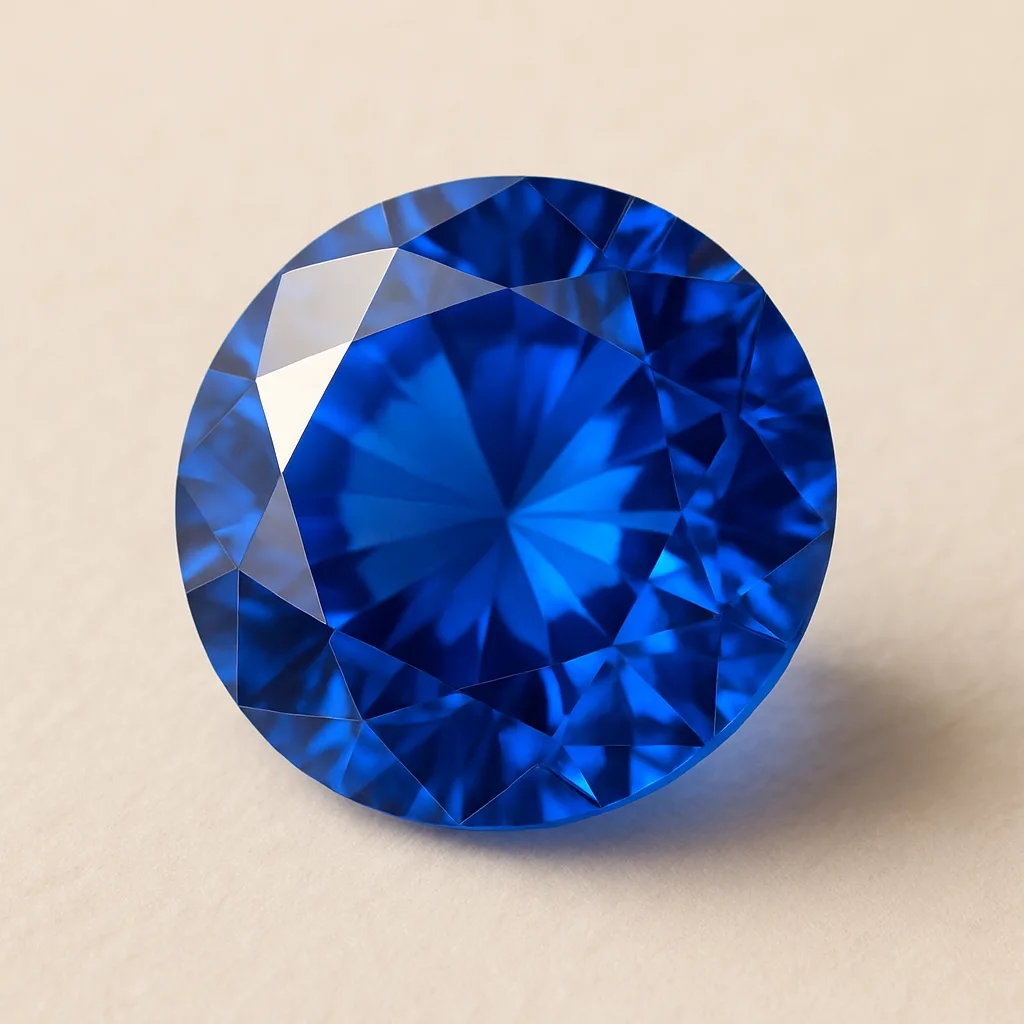
Synthetic Blue Sapphire
| Hardness | 9 |
| Specific gravity | 4.00 |
| Refractive index | 1.762-1.770 |
| Crystal system | 六方晶系(三方晶系) |
Pale cornflower blue through saturated royal blue to deep navy. Modern synthetic blue sapphire is typically produced in pre-selected color saturations matching commercial demand — clean, even saturation with no color zoning, often more uniform than natural material from any single origin. Some flux-grown material specifically targets the velvety Kashmir blue tone.
- Verneuil flame-fusion: visible at 10× under immersion
- Verneuil: round gas bubbles, often in trails or clusters
- Flux-grown: wispy 'breadcrumb' flux residue and platinum crucible flakes
- Hydrothermal: chevron (V-shaped) growth patterns, seed-crystal slabs
- nclusions
- Doubly refractive (uniaxial negative) — identical to natural blue sapphire
- Strong dichroism — deep blue and greenish-blue along different optical directions
- 0.008–0.009
- Vitreous to sub-adamantine luster
- 01 visible under 10× immersion are the diagnostic feature of Verneuil flame-fusion
- 02Round gas bubbles indicate synthetic (flame-fusion) or glass
- 03Wispy flux residue or platinum flakes indicate flux-grown synthetic
- 04Suspiciously uniform color with no natural zoning is a synthetic warning sign
- 05Lab reports with LA-ICP-MS trace-element analysis are essential for high-end purchases — Russian hydrothermal material can mimic Kashmir natural sapphire visually
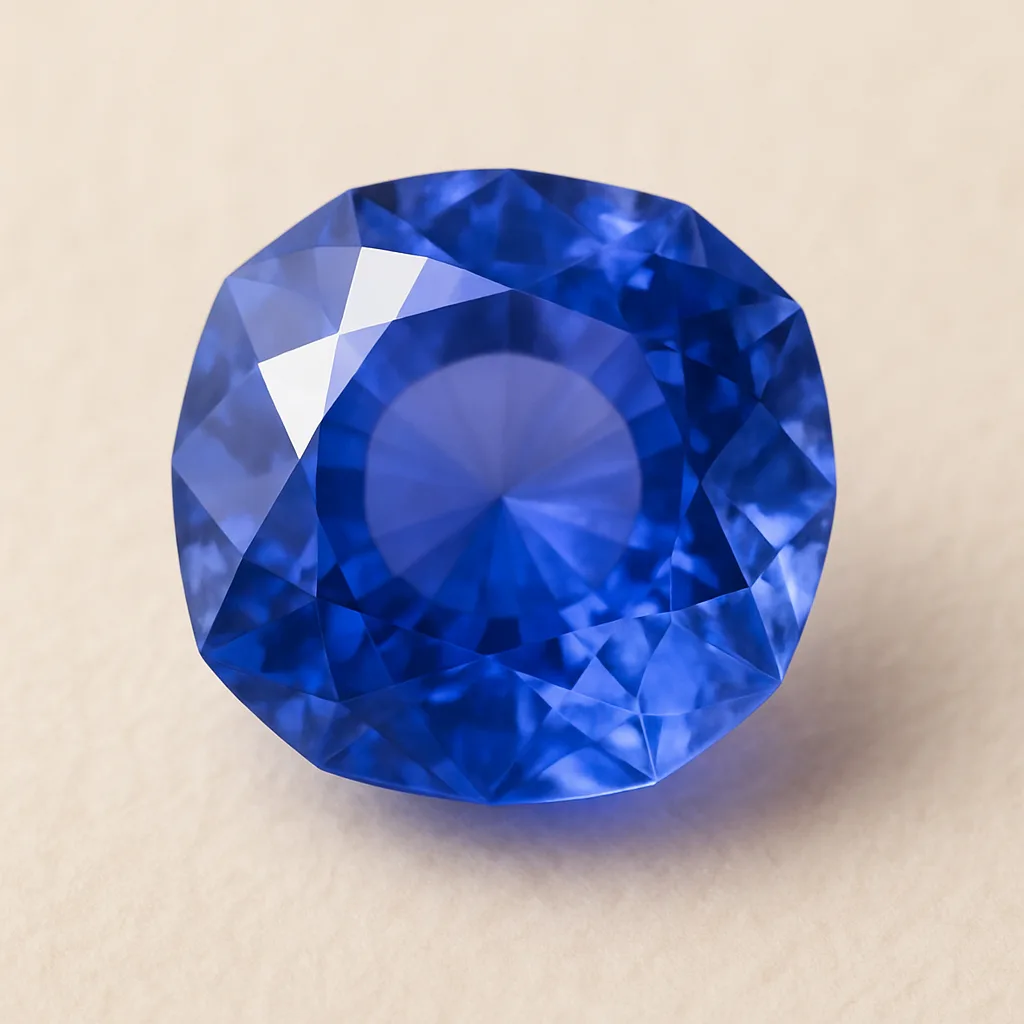
- Mohs 9 with no — extremely durable for everyday wear
- Ultrasonic and steam cleaning are safe
- Stable to light and normal cleaning chemicals
Roughly $3–$20/ct for commercial Verneuil flame-fusion synthetic blue sapphire in standard sizes, $30–$150/ct for high-quality flux-grown Chatham material, and $100–$500/ct for premium hydrothermal Tairus sapphires with natural-looking color and inclusions. Industrial-grade material trades by the kilogram in non-gem markets.
Note: Disclosure is mandatory under modern trade-naming standards (CIBJO, JIS, FTC). 'Created blue sapphire,' 'lab-grown blue sapphire,' and 'synthetic blue sapphire' are acceptable terms. The biggest market concern is high-end Russian hydrothermal material that can be visually indistinguishable from natural Kashmir or Burmese sapphire — lab reports from GIA, GRS, or AGL using LA-ICP-MS and advanced FTIR are essential for any high-value purchase. Mid-20th-century Verneuil sapphires in estate jewelry sometimes pass through second-hand markets without proper labeling.
Synthetic blue sapphire is Al₂O₃ : Fe, Ti — the same composition as natural blue sapphire with the same Fe²⁺ → Ti⁴⁺ charge transfer producing the characteristic blue body color. The 1909 Verneuil announcement that flame-fusion could be extended to blue corundum was a significant technical achievement, requiring precise control of iron-titanium ratios and reducing atmospheres during boule growth. Modern industrial production is enormous — Verneuil blue sapphire is the standard material for watch crystals, watch jewels, scratch-resistant smartphone camera covers, and laser windows, with jewelry consumption representing a minor fraction of total production.
Origins
Swiss Djeva (Monthey) was the original Verneuil corundum producer. Russian, Thai, and Chinese plants now dominate global Verneuil blue sapphire production by volume — Chinese facilities alone produce thousands of kilograms annually for industrial substrate and jewelry markets. Flux-grown synthetic blue sapphire is produced by Chatham (San Francisco, since the 1970s) and historically by Kashan (Texas, 1970s–1990s). Hydrothermal blue sapphire comes from Russian Tairus (Novosibirsk, since the 1990s) and a handful of specialized labs. The hydrothermal material is significantly more difficult to distinguish from natural Kashmir or Burmese sapphire and requires advanced lab analysis.
History
Auguste Verneuil announced his blue sapphire synthesis in 1909, extending his 1902 ruby process to iron-titanium-doped corundum. The technical breakthrough — controlling the Fe-Ti ratio and the reducing atmosphere — was significant and immediately commercialized. Throughout the Art Deco period of the 1920s and 1930s, synthetic blue sapphire was the dominant blue stone in costume jewelry and even some signed-designer pieces (with proper disclosure). Wartime production during WWII focused on synthetic sapphire for watch jewels and instrument bearings, with massive Allied and Axis demand. The post-war era saw Verneuil corundum become a ubiquitous industrial material. Chatham flux synthesis arrived in the 1970s with significantly more natural-looking material. The Russian hydrothermal era beginning in the 1990s introduced material so natural-looking that GIA lab analysis became essential for distinguishing high-end Russian hydrothermal sapphire from natural Kashmir material — a still-ongoing concern in the auction-house market.
Lore & symbolism
September's birthstone (synthetic versions accepted as substitutes for natural blue sapphire). Synthetic blue sapphire has no traditional folklore — it postdates the lapidary tradition. Modern crystal writing positions it as a stone of accessible wisdom and democratized truth.
Tools to confirm this stone
Tools that help confirm Synthetic Blue Sapphire. Tap any item to jump to the matching section on the gem tools page.
- 最終確認日
- 2026年4月28日
- 参 考 文 献
- Gem Encyclopedia/ GIA (Gemological Institute of America)
- 宝石鑑別基準/ 中央宝石研究所 (CGL)
- Mineral & Gem Database/ Mindat.org / Gemdat.org
- 宝石学入門/ 全国宝石学協会
本ページの物性値(屈折率・比重・硬度・結晶系等)は、上記の権威ある一次資料を相互参照して編集しています。最新の鑑別研究の進展により値が更新される場合があります。