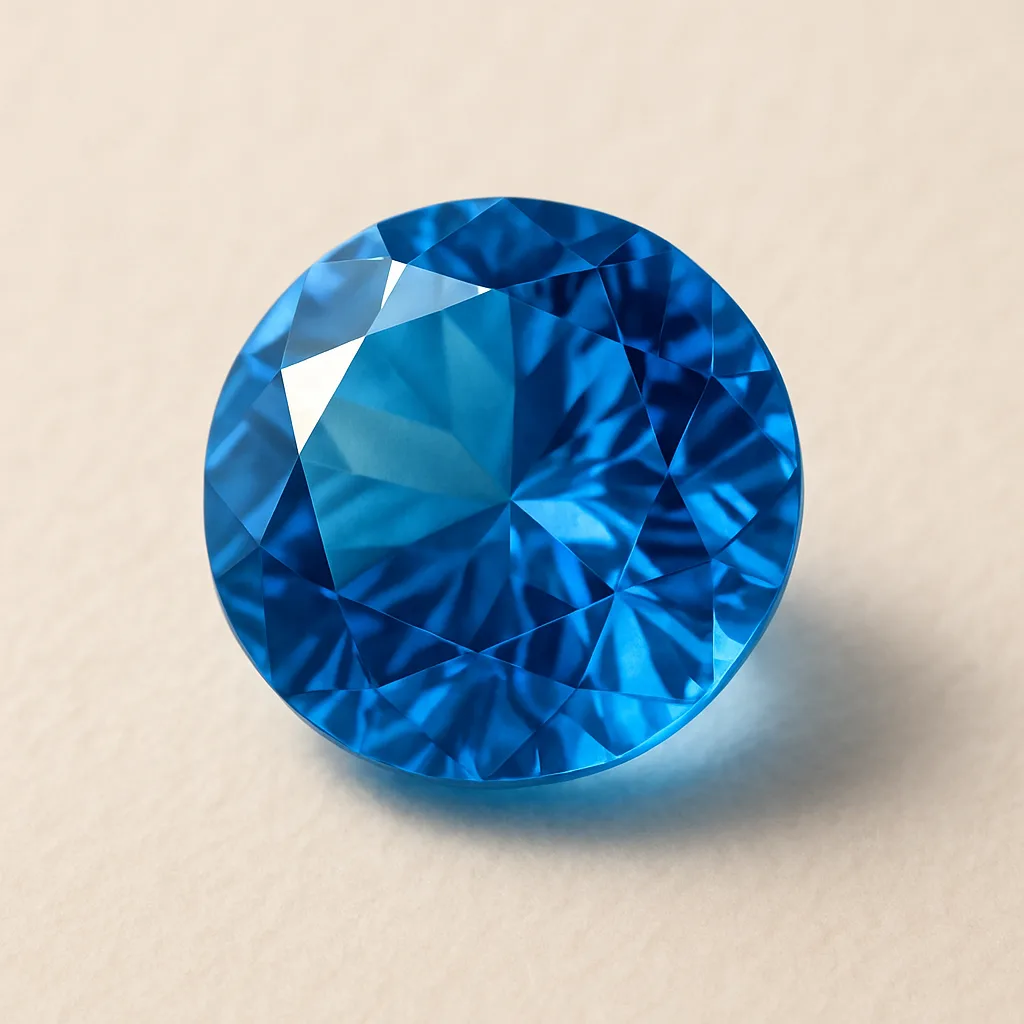
identified this stone yet
Blue Glass / Paste
| Hardness | 5-6 |
| Specific gravity | 2.40-4.20 |
| Refractive index | 1.470-1.700 |
| Crystal system | 非晶質 |
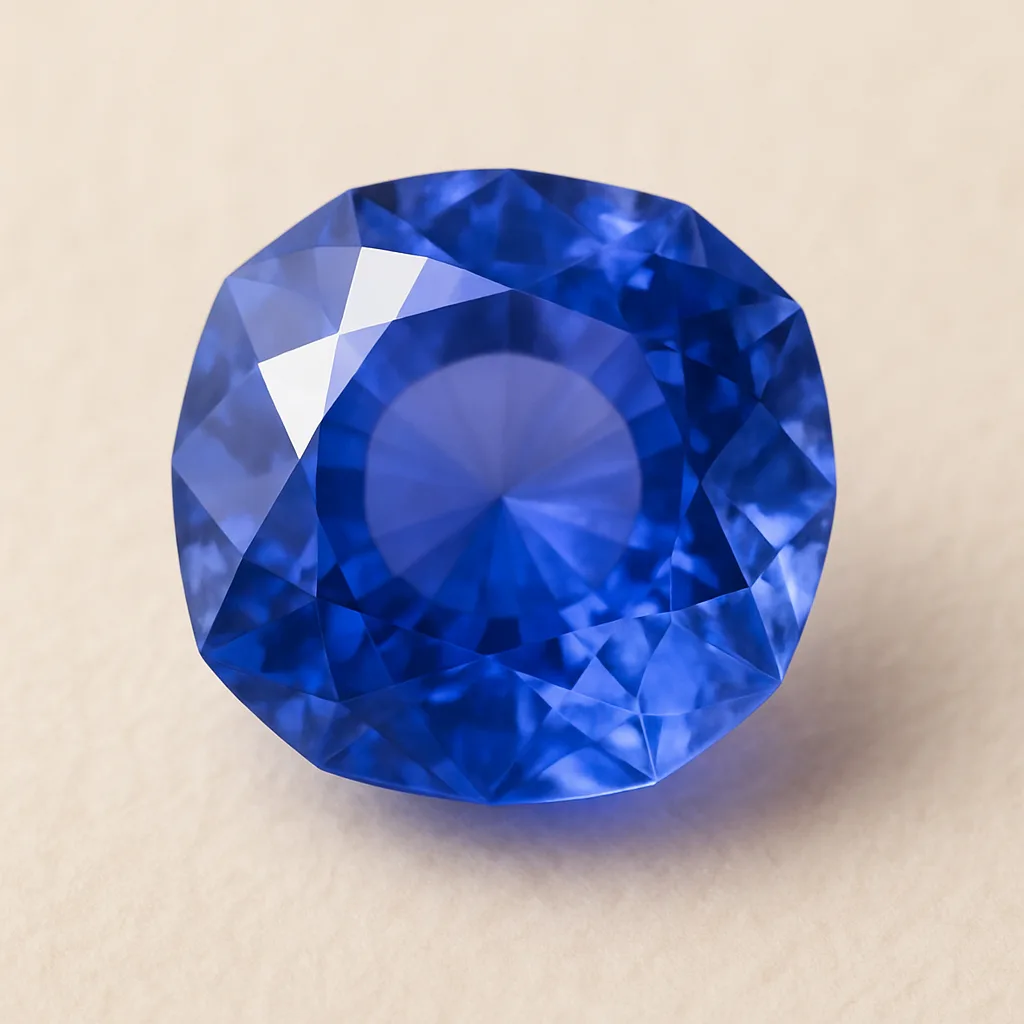
Cobalt-blue saturated royal blue (the 'Sèvres bleu' or 'Bristol blue' historical trade tones), copper-oxide pale turquoise blue, manganese-and-copper blue-green, and the rare Egyptian-blue (CaCuSi₄O₁₀) calcium copper silicate of Pliny's Naturalis Historia. Modern industrial cobalt glass at 0.5–1.0 wt% CoO closely approximates Burmese royal-blue sapphire color saturation under tungsten light, with Bohemian Gablonzer pressed-glass exhibiting the most consistent batch-to-batch color.
- Regular round gas bubbles distributed evenly through the matrix — diagnostic of pressed or molded glass at 10×
- Surface molding seams and press-die parting lines on backs
- Cobalt-rich color zoning streaks (schlieren) from incomplete batch mixing
- Devitrification crystallites (microscopic re-crystallization) in older or heat-stressed material
- Lampwork beads: spiral flow lines from the molten-glass winding around the mandrel
- Singly refractive (amorphous glass structure) — no at any orientation
- Refractive index 1.50–1.70 depending on lead content (Bristol Blue and Strass paste 1.55–1.70, soda-lime 1.50–1.52)
- Specific gravity 2.4–4.5 — lead-crystal at the high end, soda-lime at 2.4–2.5
- Mohs 5–6 — easily scratched by quartz (Mohs 7) and by steel knife (Mohs 5.5+)
- Conchoidal fracture — characteristic curved breakage diagnostic of amorphous materials
- Chelsea filter: cobalt-blue glass appears red under the standard cobalt-chrome Chelsea filter, a diagnostic distinct from natural sapphire (no Chelsea response)
- 01Regular round gas bubbles visible at 10× — immediately diagnose pressed or molded glass; natural sapphire never shows this signature
- 02Singly refractive (no ) versus natural sapphire's strong visible at 30× immersion through the table
- 03Chelsea filter shows red for cobalt-blue glass — natural blue sapphire stays blue or grey; instant field diagnosis
- 04Refractometer reads 1.50–1.70 versus natural sapphire's 1.762–1.770
- 05Mohs 5–6 scratches against a steel knife or hardened-steel file; natural sapphire (Mohs 9) is unaffected
- 06Specific gravity 2.4–4.5 versus natural sapphire's 3.99–4.01 — hand-heft gives diagnostic difference at 1 ct and above
- Mohs 5–6 — stores separately to avoid scratches from quartz, garnet, or harder gems
- Avoid ultrasonic cleaning — vibration can crack the brittle glass matrix
- Stable to light and standard mild detergent; warm soapy water and soft brush
- Avoid thermal shock (rapid temperature changes) — conchoidal fracture risk
- Avoid contact with strong acids and bases — surface etching possible on lead-crystal material
Modern molded and faceted cobalt-blue cabochons trade at $0.30–$3 per piece wholesale (Indian and Chinese mass production); Czech Gablonzer pressed-glass and lampwork material runs $2–$25 per piece depending on cut quality and origin documentation. High-quality Murano lampwork beads in cobalt-blue with millefiori or aventurine techniques reach $50–$300 per bead at gallery prices. Genuine eighteenth- and nineteenth-century cobalt paste (Strass-tradition French, Bristol Blue English, Bohemian Gablonzer) trades at $200–$3,000 per piece at vintage and estate auctions; museum-quality royal-attribution pieces (Marie Antoinette, Habsburg, British royal) can reach $50,000–$500,000 at major auctions.
Note: Disclosure as 'glass' or 'imitation sapphire' is mandatory under FTC Jewelry Guides §23.25, CIBJO Blue Book, and JIS Z 9529 — the trade names 'Bristol Blue' and 'Sèvres bleu' are acceptable historical references but require explicit material identification in modern retail. Beware of cobalt-blue glass marketed as 'Ceylon blue' or 'natural blue sapphire' at flea-market or unscrupulous online channels — the Mohs 5–6 hardness scratches against a steel knife where genuine sapphire (Mohs 9) does not, providing immediate field diagnosis. Czech Gablonzer pressed-glass cabochons in true cobalt blue from documented pre-WWII production command collector premiums in the antique-jewelry trade. Modern Swarovski-style faceted cobalt-blue components dominate the costume and bridal-accessory markets at $0.50–$5 per piece wholesale.
abochons, Murano (Venice, Italy) for lampwork beads, and Indian Firozabad and Chinese Shandong/Hebei factories for the mass-market costume trade. The cobalt-blue saturation closely approximates Burmese royal-blue sapphire under standard tungsten light, driving consistent demand for the material as a sapphire substitute since the eighteenth century.
Origins
abochons. Specialty 'Egyptian blue' (calcium copper silicate) reproductions are produced by a handful of European specialty firms for archaeological and museum reproduction work.
History
Egyptian blue (CaCuSi₄O₁₀) — the world's first synthetic pigment — was produced in Egypt and Mesopotamia from c. 3100 BCE and used in glass and faience; the technique was lost after the Roman period and not rediscovered until 1814 by Sir Humphry Davy's analysis of Pompeian pigment samples. Roman cobalt-blue glass appears at Pompeii and Herculaneum from the first century CE; Pliny's Naturalis Historia Book 36 (c. 77 CE) describes the coloring techniques. The Venetian cristallo tradition (Angelo Barovier, Murano, c. 1450) established medieval Italian leaded-glass production. Bohemian glass under Emperor Rudolf II in Prague (1576–1612) developed the regional industry that would become Gablonzer; the Jablonec nad Nisou pressed-glass works scaled industrially from the 1820s. Georg Friedrich Strass's Paris atelier (1730s) introduced the first commercially successful cobalt-blue paste sapphire imitations to European court jewelry, and the material was used extensively in eighteenth-century jewelry — Marie Antoinette's documented blue-paste pieces survive in the Louvre and the Victoria and Albert. Bristol Blue glass (William Cookworthy's late-eighteenth-century cobalt formulation imported from Saxony via Bristol, Avon) supplied the British apothecary-bottle and decorative-jewelry trade from the 1780s through 1923 (closure of last Bristol works). Daniel Swarovski's 1892 founding at Wattens (Tyrol, Austria) of his cut-glass factory and the 1908 Aurora Borealis coating revolutionized costume-jewelry production. The 1968 US FTC Jewelry Guides §23.25 disclosure rules required explicit 'glass' or 'imitation sapphire' labeling for trade practice.
Lore & symbolism
No birthstone designation (synthetic/imitation material). Egyptian-blue pigment carried strong religious associations in Pharaonic Egypt — the colour of Amun and the heavens — and the Roman world preserved the cobalt-blue tradition for ornamental and ritual glassware. Medieval European church glass (Chartres Cathedral c. 1145, Sainte-Chapelle 1248) established the deep cobalt blue as the chromatic signature of celestial and Marian imagery, and the secular paste tradition descending from Strass and Bristol retained the high-cultural connection. Modern crystal-writing assigns no specific spiritual properties to glass imitations; the Czech Gablonzer regional craft tradition is preserved as UNESCO intangible cultural heritage and as protected EU origin labeling for the highest grades. The 'Bristol Blue' designation remains a recognized historical mark in British antiques and decorative arts.
Tools to confirm this stone
Tools that help confirm Blue Glass / Paste. Tap any item to jump to the matching section on the gem tools page.
- 最終確認日
- 2026年4月28日
- 参 考 文 献
- Gem Encyclopedia/ GIA (Gemological Institute of America)
- 宝石鑑別基準/ 中央宝石研究所 (CGL)
- Mineral & Gem Database/ Mindat.org / Gemdat.org
- 宝石学入門/ 全国宝石学協会
本ページの物性値(屈折率・比重・硬度・結晶系等)は、上記の権威ある一次資料を相互参照して編集しています。最新の鑑別研究の進展により値が更新される場合があります。