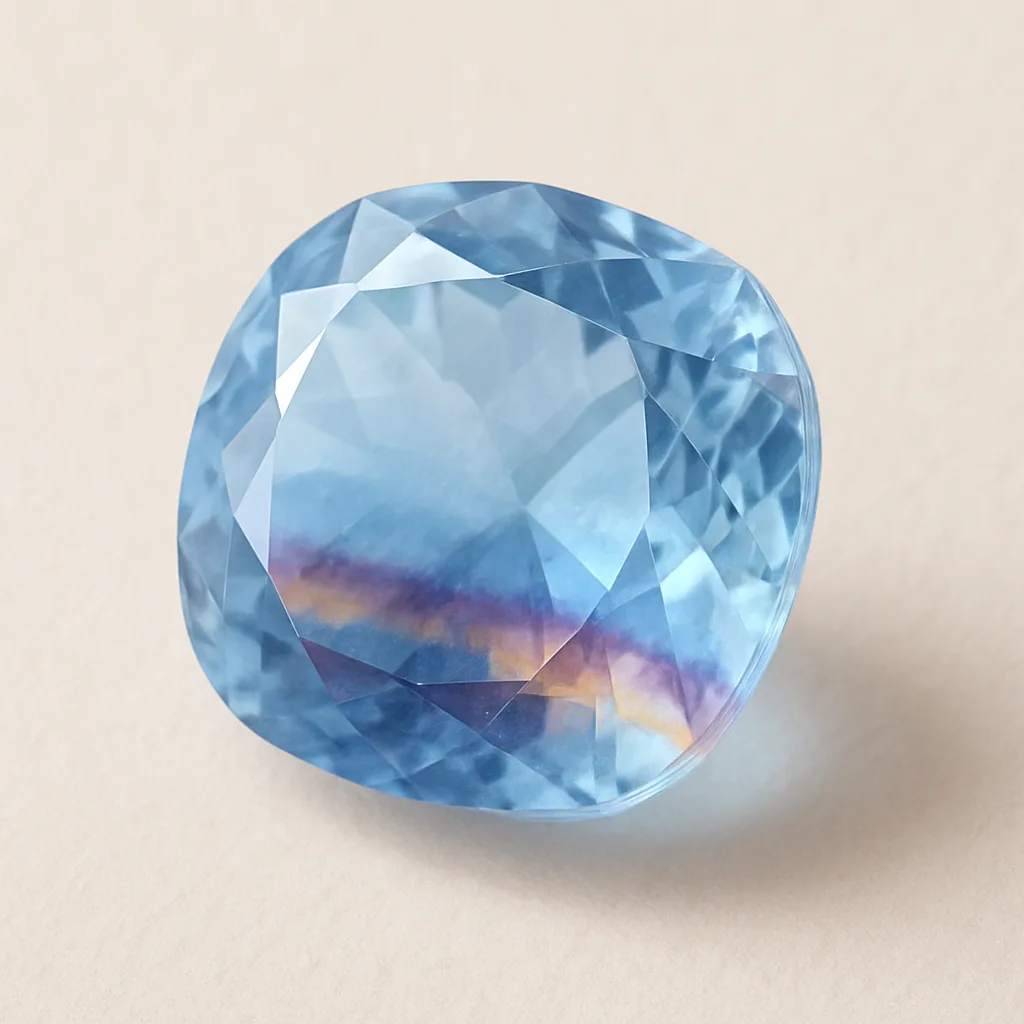
identified this stone yet
Blue Fluorite
| Hardness | 4 |
| Specific gravity | 3.18 |
| Refractive index | 1.434 |
| Crystal system | 等軸晶系 |
Pale sky-blue to deep cobalt-blue, often with bands. The Castleton Blue John shows characteristic alternating purple, yellow, and pale-blue bands (12 named varieties from the type locality: Treak Cliff Blue, Old Tor Vein, Twelve Vein, Bull Beef, Five Vein, Organ Room, Landscape, and others). Hunan Chinese material is more uniform, deep cobalt-blue.
- planes visible as four sets of parallel reflective surfaces at the octahedral angles — diagnostic at 10×
- Colour banding and zoning from differential trace-element substitution during crystal growth
- egative crystals showing cubic faces)
- nclusions in dark or 'oil-fluorite' material from Wölsendorf and the Illinois-Kentucky district
- nclusions of barite, galena, sphalerite (from epithermal-vein paragenesis)
- Triangular 'pits' on damaged surfaces — diagnostic feature
- Refractive index 1.434 — one of the lowest among gem minerals, calibration reference for the low-RI end of the refractometer
- Singly refractive (isotropic cubic ) — no
- Perfect octahedral in four directions — produces characteristic triangular faces
- Mohs 4 — the standard reference for hardness 4 on the Mohs scale
- Specific gravity 3.18
- Strong blue-to-violet luorescence' itself was coined for this mineral
- 0.007 — low , no 'fire' compared with diamond (0.044)
- 01Strong blue or violet under 365 nm UV — diagnostic single-test identifier separating from all other blue gem materials
- 02Refractive index 1.434 on the refractometer — diagnostic for fluorite (overlap only with opal at 1.430–1.460 and the polymer-acrylic at 1.49–1.50, both easily separated by other tests)
- 03Mohs 4 — scratches with a Mohs-5 knife edge; aquamarine (Mohs 7.5) and blue topaz (Mohs 8) are dramatically harder
- 04Four-direction octahedral visible as four sets of parallel reflective planes — diagnostic versus calcite's three-direction rhombohedral
- 05Specific gravity 3.18 — separates from blue calcite (2.69–2.71) and blue topaz (3.49–3.57)
- 06Cubic-system isotropic single refraction — separates from doubly refractive blue calcite, blue topaz, and aquamarine
- Mohs 4 — easily scratched, store separately from harder gemstones
- Perfect octahedral in four directions — extreme caution against impact; even minor knocks will fracture along planes
- No ultrasonic cleaning, no steam cleaning — vibration and heat fracture the
- Avoid temperatures above 200°C — colour bleaches reversibly above 350°C
- Acid-sensitive surface (HF will dissolve the species; even dilute HCl etches the polish)
- Limit jewelry use to pendants, earrings, and brooches; rings are inappropriate due to fragility
Wholesale blue-fluorite cabochons and beads at $2–$30 per piece; faceted Hunan Chinese gemstones at $5–$50 per carat for clean medium-saturation material; Castleton Blue John authenticated ornamental pieces (small bowls, candle holders) at $200–$3,000 per piece direct from the two operating caverns; antique Boulton-Watt 18th–19th-century Blue John vases reach $10,000–$200,000+ at major auction (Sotheby's, Christie's English furniture sales). Mont Blanc pink fluorite (not blue, but the same species) at the same price tier or higher for exhibition crystals. Collector-grade Okorusu Namibian blue octahedra at $50–$2,000 per crystal cluster.
Note: Disclosure as 'natural fluorite' is required; heat-treatment to deepen colour or bleach unwanted purple is occasionally encountered and must be disclosed under FTC Jewelry Guides §23.22 and CIBJO Blue Book. The Castleton Blue John material is sold only as authenticated ornamental and lapidary pieces from the two operating caverns under English Heritage conservation oversight — most retail 'Blue John' jewelry outside Castleton uses Chinese or Mexican material with imitation banding. The Hunan Chinese gem-cutting rough is the price reference for faceted material. Beware ultrasonic and steam cleaning which fracture the perfect octahedral cleavage; beware temperature-induced colour bleaching above 350°C; beware acid which etches the surface. The collector specimen market values undamaged crystal habit (cubic, octahedral, or 'twinned penetration cubes') over colour saturation.
Fluorite (CaF₂) is the calcium-fluoride mineral that crystallizes in the cubic isometric system, producing famous cubic and octahedral crystals. The blue variety derives its colour from a combination of trace Y³⁺/REE substitution and natural radiation-induced colour centres — the same mechanism that produces purple Castleton Blue John and that responds reversibly to heating (above 350°C the colour bleaches). Mohs 4 (the standard Mohs reference for hardness 4), SG 3.18, refractive index 1.434 (one of the lowest among gem minerals — the standard 'low-RI' end of the refractometer calibration range), perfect octahedral in four directions producing characteristic triangular faces visible at 10×. Singly refractive, isotropic. The cubic-system symmetry and the geometry are the classical mineralogy teaching example.
Origins
Castleton, Derbyshire, England — exclusively at Treak Cliff Cavern and Blue John Cavern, the only world localities for the banded purple-blue-yellow ornamental variety known as 'Blue John' (a contraction of the French bleu-jaune). The two operational mines extract approximately 500 kg per year combined, working a vein system in Carboniferous limestone that has been continuously mined since at least the 1760s and possibly since Roman times. Hunan Province, China (post-2010 the dominant world source for clear blue and purple fluorite gem-cutting rough — Yaogangxian and Xianghualing mines), Namibia (Okorusu mine, blue and green octahedra), the United States (the Illinois-Kentucky Fluorspar District at Cave-in-Rock and Rosiclare, supplying the 'Rosiclare blue' octahedron specimens), Mexico (Las Cuevas, San Luis Potosí), Germany (the historic Wölsendorf, Bavaria deposits), and the Alps (Mont Blanc and Argentière, France) are the major modern and historical sources. The Mont Blanc 'pink fluorite' from the Aiguilles Rouges massif is the world's premier collector specimen variety, though pink rather than blue.
History
luorescence' in his 1852 Cambridge paper on the violet-blue luminescence of Castleton fluorspar — the rare instance of a chemical-physical phenomenon being named after the mineral that exemplifies it. The 20th-century decline at Castleton was reversed in the 1960s when small-scale mining at Treak Cliff and Blue John caverns reopened for the souvenir and modern lapidary trade. The Chinese Hunan deposits emerged as the dominant world source for blue and purple gem-cutting rough from c. 2010 onward.
Lore & symbolism
No traditional birthstone designation. In the modern crystal-healing tradition (Melody 1995, Hall 2003), blue fluorite is associated with the throat chakra, mental focus, and stress reduction — the 'Genius Stone' or 'Stone of Discernment' in metaphysical lore. The 18th- and 19th-century English aristocratic association with Castleton Blue John gives the variety a distinctive cultural resonance — owning a Boulton-Watt fluorite vase remains a recognized marker of Georgian-era English country-house heritage. The connection makes blue fluorite a popular specimen for 365 nm UV-torch demonstrations at mineral fairs and museum education programs (Castleton Blue John Cavern offers a UV-tour for visitors).
Tools to confirm this stone
Tools that help confirm Blue Fluorite. Tap any item to jump to the matching section on the gem tools page.
- 最終確認日
- 2026年4月28日
- 参 考 文 献
- Gem Encyclopedia/ GIA (Gemological Institute of America)
- 宝石鑑別基準/ 中央宝石研究所 (CGL)
- Mineral & Gem Database/ Mindat.org / Gemdat.org
- 宝石学入門/ 全国宝石学協会
本ページの物性値(屈折率・比重・硬度・結晶系等)は、上記の権威ある一次資料を相互参照して編集しています。最新の鑑別研究の進展により値が更新される場合があります。