identified this stone yet
Blue Calcite
| Hardness | 3 |
| Specific gravity | 2.71 |
| Refractive index | 1.486-1.658 |
| Crystal system | 三方晶系 |
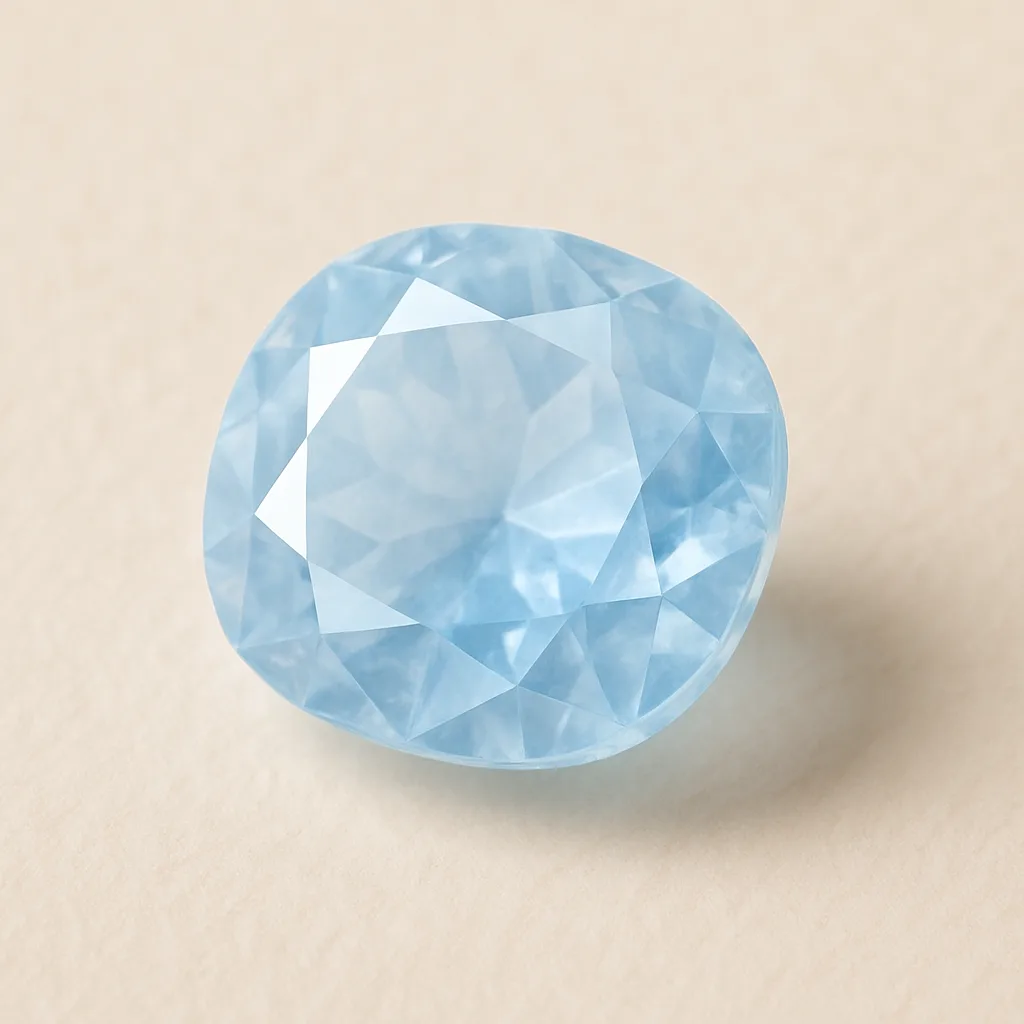
Pale powder-blue to soft sky-blue, often with white banding and translucent-to-opaque diaphaneity. The Mexican Chihuahua material — the standard market reference — sits between hexcode #A8C8DC and #B3D4E5. Bands of white, grey, and lavender are common, reflecting changes in chromophore concentration during deposition.
- cracks along the three rhombohedral directions (75° angle) — diagnostic at 10×
- Colour banding and zoning from variable chromophore concentration during deposition
- Secondary calcite veinlets crosscutting the matrix
- Iron oxide stains along fracture surfaces in some Mexican material
- nclusions (rare but diagnostic when present)
- Twinning lamellae visible under crossed polars
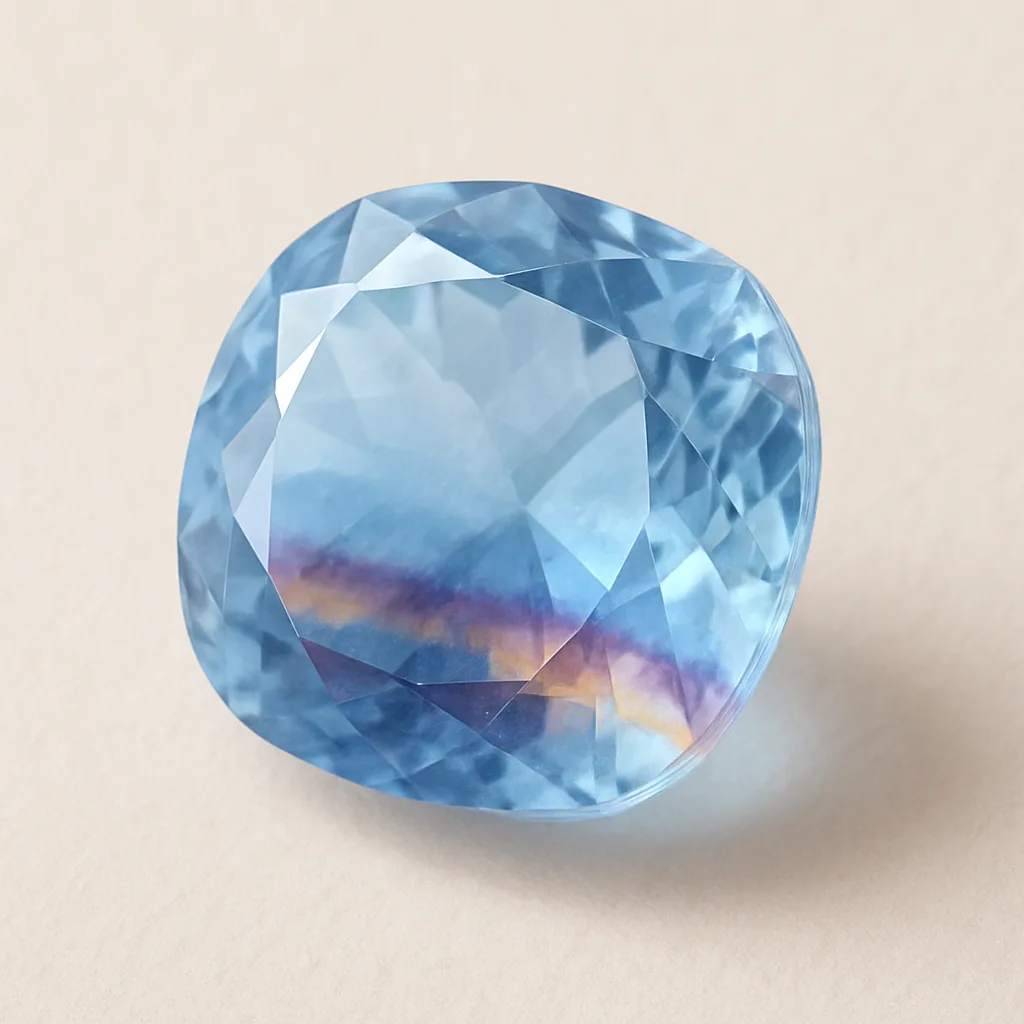
- Extraordinary of 0.172 — the highest among common gem minerals, producing visible of underlying text through a 5 mm
- Perfect rhombohedral in three directions at 75° — the Bartholin signature
- Uniaxial negative optic character with refractive indices ω 1.658 (ordinary), ε 1.486 (extraordinary)
- Mohs 3 — easily scratched by a copper coin (Mohs 3.5)
- Specific gravity 2.69–2.71
- Brisk effervescence in dilute HCl — diagnostic of calcium carbonate, separates from dolomite (slow effervescence) and aragonite (same composition but orthorhombic system)
- 01Diagnostic test — placing a 5 mm over printed text shows visible ; no other common blue gem material produces this magnitude of
- 02Brisk effervescence in dilute HCl confirms carbonate composition — separates from dyed howlite (borate, no effervescence) and dyed quartz (no reaction)
- 03Mohs 3 — scratches easily with a copper coin or fingernail; aquamarine (Mohs 7.5) and blue topaz (Mohs 8) are dramatically harder
- 04Rhombohedral visible as three sets of parallel reflective planes at 75°
- 05Refractive index 1.486–1.658 (extraordinary/ordinary) — diagnostic on the refractometer with the large reading
- 06Specific gravity 2.69–2.71 — separates from blue fluorite (3.18) and blue topaz (3.49–3.57)
- Mohs 3 — extremely soft, easily scratched by everyday surfaces and most other gemstones
- Acid-sensitive — avoid skin perspiration, vinegar, citrus juices, household cleaners, and any acidic environment
- No ultrasonic cleaning, no steam cleaning — both will crack along planes
- Clean with a soft dry cloth or a barely-damp cloth and immediate drying
- Store separately from harder gemstones to prevent scratching
- Limit jewelry use to pendants, earrings, and brooches where impact risk is low; avoid rings and bracelets
Wholesale tumbled stones and rough at $1–$10 per piece; cabochons and beads at $5–$50 each depending on size and translucency; larger lapidary carvings (palm stones, wands) at $20–$300; rare exhibition-grade Mexican Chihuahua material with strong sky-blue saturation and good clarity at $100–$800. Antique Egyptian alabaster (calcite) vessels reach museum-collection prices in the thousands to tens of thousands of US dollars at auction (Sotheby's, Christie's, Bonhams ancient-art sales).
Note: Disclosure as 'natural calcite' or 'blue calcite' is required; the material is generally untreated though waxing and resin-impregnation for stabilization is occasionally seen and must be disclosed per FTC Jewelry Guides §23.22 and CIBJO Blue Book. Beware of 'blue calcite' marketing for material that is actually dyed white calcite or even dyed howlite — the diagnostic test is brisk effervescence in dilute HCl (carbonate) plus the 0.172 birefringence (textbook doubling visible with a 10× loupe). Mexican Chihuahua material is the price reference; specimens with strong sky-blue saturation and good translucency command moderate premiums. The metaphysical/healing market drives most volume; the lapidary market is secondary.
Blue calcite (CaCO₃) is the pale-blue variety of calcite — the calcium-carbonate species that anchors Mohs's 1812 hardness scale at position 3 (the original Wiener Mineralienkabinett reference specimen). The colour derives from trace copper or organic chromophores incorporated during sedimentary or hydrothermal deposition. As the optical textbook mineral for double refraction (Bartholin 1669, Huygens 1690 Traité de la Lumière), it shows a famous 0.172 that produces visible of underlying text — the diagnostic field test still taught in every gemology curriculum. Mohs 3, SG 2.69–2.71, RI 1.486–1.658 (extraordinary/ordinary rays), perfect rhombohedral abochons, beads, and ornamental carvings because of the low hardness and reactivity to common skin acids.
Origins
Mexico (Chihuahua state — particularly the El Calicheño and La Encantada districts, and Sinaloa state) is the dominant world source of gem-quality blue calcite, supplying the powder-blue to sky-blue translucent-to-opaque material that dominates the lapidary trade. The United States (Colorado, particularly the Leadville and Aspen mining districts; New Mexico; Tennessee Sweetwater district), Peru (Pasco region), Germany (Harz Mountains), Namibia (Tsumeb — historically famous for crystals though more often colourless or pink), and Zambia (Kabwe) also produce blue calcite at smaller scale. The historic Iceland spar from the Helgustaðir mine in Eskifjörður, eastern Iceland — discovered 1668 by Rasmus Bartholin's collaborator and effectively exhausted by the early 20th century — provided the optically perfect colourless specimens that built classical optics; replacement Iceland-spar specimens from Mexico (Sinaloa) and Brazil (Minas Gerais) have served scientific and instrument-grade demand since c. 1920.
History
Calcite has been worked as a decorative stone since antiquity — the Egyptian alabaster vessels of the Old Kingdom (c. 2700–2200 BCE) are technically banded calcite-aragonite rather than true gypsum alabaster, and 'Egyptian alabaster' remains the Egyptological term for this material. Pliny the Elder's Naturalis Historia Book 36 (c. 77 CE) describes lapis alabastrites — the same banded calcite — used for ointment jars and small vessels at Pompeii and Herculaneum. The mineralogical history begins decisively in 1669 when the Danish polymath Erasmus Bartholin, working at the University of Copenhagen with crystals from the Helgustaðir mine in Iceland, published 'Experimenta crystalli Islandici disdiaclastici' describing the of images through calcite — the founding observation of crystal optics. Christiaan Huygens extended the analysis in his 1690 Traité de la Lumière, formulating the principle of polarization. William Nicol's 1828 Edinburgh prism (the Nicol prism, two calcite halves cemented with Canada balsam) became the standard polarizer for petrographic microscopes until the mid-20th century synthetic-polarizer revolution. The Mexican 'onyx-marble' trade — banded calcite from Chihuahua sold as Egyptian-style decorative carvings — flourished from the 1880s through the post-WWII tourist economy and remains a regional industry. The 20th-century New Age and crystal-healing markets reframed blue calcite as a 'throat-chakra' communication stone from the 1970s onward.
Lore & symbolism
No traditional birthstone designation. In the modern Western crystal-healing tradition (Melody's 'Love Is in the Earth' 1995 and the broader New Age corpus), blue calcite is associated with the throat chakra, communication, calming, and recovery from emotional exhaustion — a placement consistent with the soft sky-blue colour. The Egyptian 'alabaster' tradition (technically calcite) carried associations with purification, mummification ritual, and the goddess Bast (Bastet) — calcite jars holding the canopic preservation of organs and consecrated oils were standard funerary furniture from the Old Kingdom through the Ptolemaic period. The Bartholin double-refraction discovery gives calcite an honoured place in the history of optics and is celebrated annually in the Royal Danish Academy of Sciences memorial.
Tools to confirm this stone
Tools that help confirm Blue Calcite. Tap any item to jump to the matching section on the gem tools page.
- 最終確認日
- 2026年4月28日
- 参 考 文 献
- Gem Encyclopedia/ GIA (Gemological Institute of America)
- 宝石鑑別基準/ 中央宝石研究所 (CGL)
- Mineral & Gem Database/ Mindat.org / Gemdat.org
- 宝石学入門/ 全国宝石学協会
本ページの物性値(屈折率・比重・硬度・結晶系等)は、上記の権威ある一次資料を相互参照して編集しています。最新の鑑別研究の進展により値が更新される場合があります。