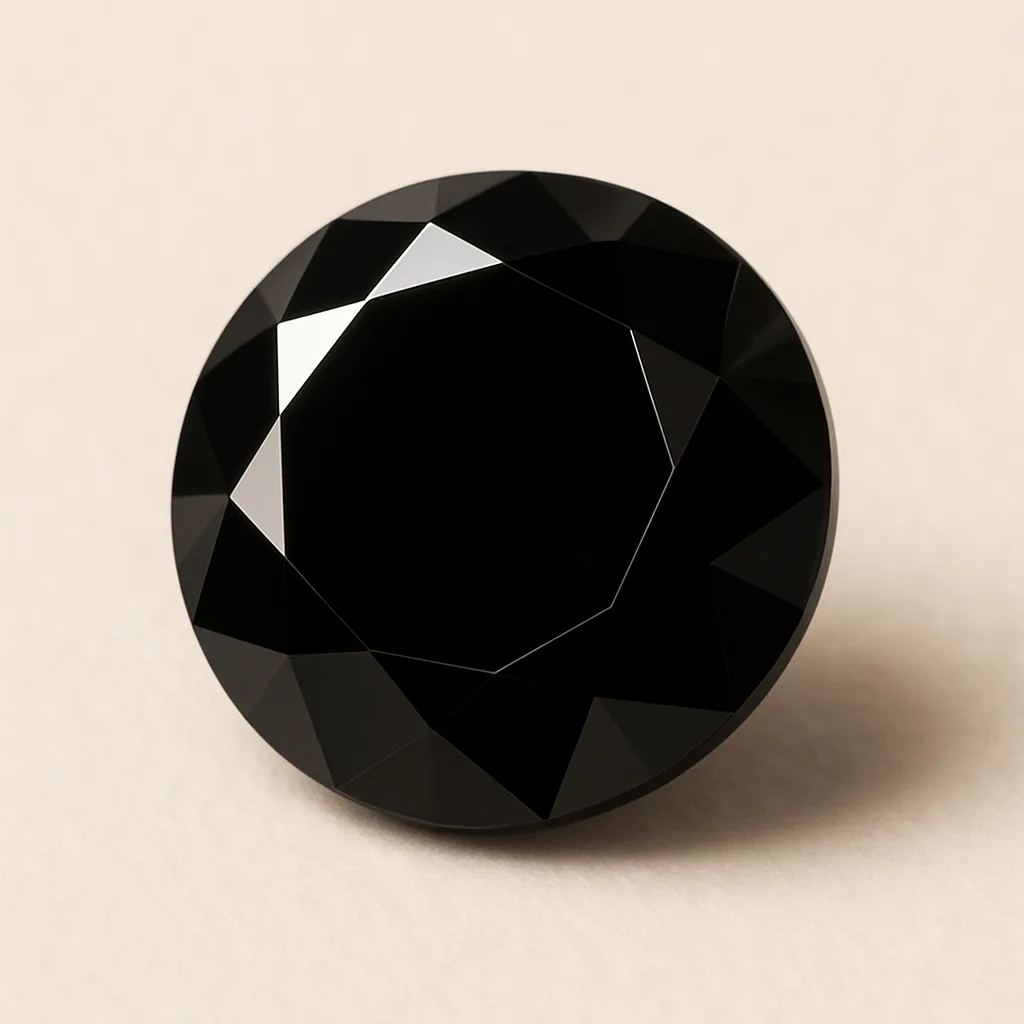
identified this stone yet
Black Zircon
| Hardness | 6-7.5 |
| Specific gravity | 4.60-4.80 |
| Refractive index | 1.810-2.024 |
| Crystal system | 正方晶系(メタミクト化でアモルファス化する場合あり) |
Deep mahogany-brown through coffee to opaque jet-black; the color is produced by combined Fe²⁺ / Fe³⁺ / U / Th absorption layered on top of metamict-driven scattering. Strongly metamict stones often shift toward greenish-black under transmitted light — the same phenomenon that gives 'green zircon' its color and that Anderson 1947 used as a field indicator of low-zircon status. Colombian and Tanzanian material tends toward warmer mahogany; Cambodian Ratanakiri toward cooler near-black.
- nclusions in surrounding host material — the diagnostic petrographic signature of zircon used in radiometric dating
- Internal cloudiness from progressive metamictization (radiation-damage scattering)
- nclusions along healed fractures
- nclusions: apatite, monazite, biotite (especially in pegmatitic specimens)
- Tetragonal (uniaxial positive) — variable from 0.059 (high zircon) down to ~0.000 in fully metamict (low) zircon
- Refractive index 1.78–1.99 (declining with metamictization)
- Specific gravity 3.95–4.7 (declining with metamictization — a strong field indicator)
- Strong 0.039 — comparable to diamond's 0.044
- Brittle with imperfect ; conchoidal-to-uneven fracture
- 01High SG (3.95–4.7) is the single most useful field test — black tourmaline (3.0–3.3), black spinel (3.6), and black obsidian (2.4) are all dramatically lighter
- 02Strong visible at 10× through any open back (in non-metamict stones); metamict stones lose but retain SG signature
- 03Strong gives characteristic colored fire on edges even in dark material
- 04Negligible UV response; Anderson's high / medium / low classification correlates with declining SG and RI
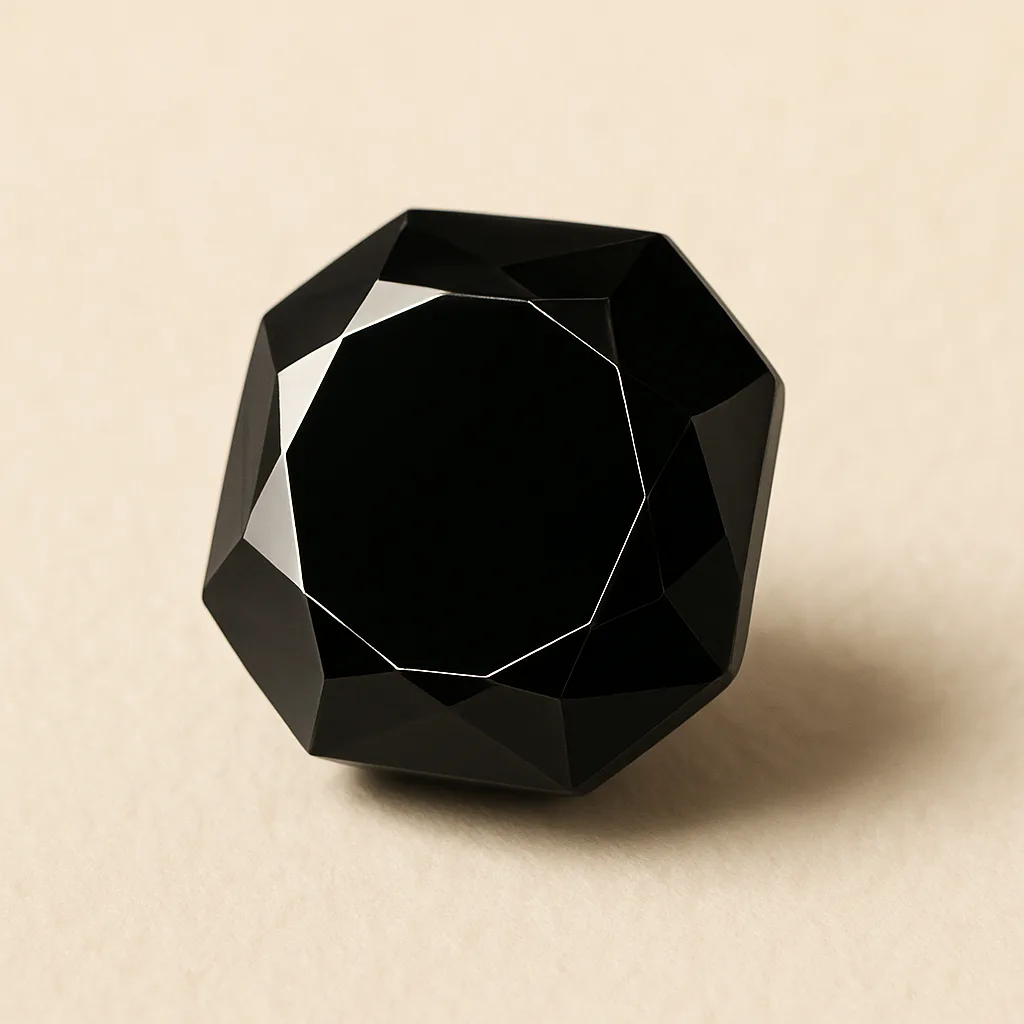
- Imperfect and brittle nature — edges chip readily; bezel and protective settings preferred over prong
- Radioactivity is negligible but non-zero — large parcels are bulk-screened in some jurisdictions
- Ultrasonic cleaning generally not recommended due to fracture-prone nature
- Stable to light and standard cleaning chemicals; avoid prolonged heat exposure (can re-anneal metamict structure unpredictably)
Black zircon trades at approximately $5–$80 per carat at the dealer level for clean, well-cut faceted material; cabochons and beads run $10–$200 per strand. Specimen-grade Mud Tank crystals from Australia trade as mineralogical specimens at $50–$500. Vintage 'jacinth' jewelry from late-19th to early-20th century European workshops occasionally surfaces in estate auctions at significant premium for the antique setting and provenance.
Note: Cambodian Ratanakiri (Bo Kheo) is the principal commercial source for cut and bead-grade material. Buyers should be aware that 'black zircon' is sometimes a trade marketing label for any sufficiently dark Ratanakiri material — bench testing for SG, RI, and birefringence is essential to distinguish from black tourmaline, black spinel, and dyed black quartz. Cambodian parcels are typically sold ungraded by carat or per-stone in Chanthaburi, Bangkok, and Hong Kong wholesale markets. The radioactive content is negligible for normal handling but exceeds typical gemstone background — bulk shipments are screened in some jurisdictions.
Black zircon (ZrSiO₄) is the dark-brown to opaque-black variety of nesosilicate zircon in which uranium-238 / thorium-232 α-decay has progressively destroyed the tetragonal crystal lattice — the metamictization process that Brøgger established in 1893 as the cause of zircon's variable density (4.0–4.7), refractive index (1.78–1.99), and (0.000–0.059). Bohdan W. Anderson's 1947 'high / medium / low zircon' classification (in his foundational Gem Testing) sorts surviving crystallinity: black zircon typically falls in the medium-to-low range, with SG 3.95–4.4 and depressed . Mohs 6–7.5 (lower in metamict material), brittle with imperfect . The radioactive content is gemologically negligible — orders of magnitude below regulatory limits — but jewellers in Bangkok and Chanthaburi who handle Ratanakiri parcels in volume occasionally use bulk dosimetry as a quality-control indicator.
Origins
Cambodia (Ratanakiri Province, Bo Kheo district — the same alluvial gravels that yield the celebrated heat-treated blue Starlite) is the principal commercial source of dark and metamict zircon worldwide. Australian New South Wales (Mud Tank carbonatite, Northern Territory; New England zircon fields) yields large opaque crystals widely used for U-Pb dating reference standards (Mud Tank zircon is a SHRIMP geochronology standard at the Australian National University). Tanzania (Morogoro), Madagascar (Tritriva), Russian Ural and Kola Peninsula material occurs as accessory crystals in syenites and pegmatites. The 4.404-Ga Jack Hills detrital zircons (Wilde, Valley, Peck & Graham 2001 Nature) — Earth's oldest known terrestrial mineral grains — are dark, metamict, and fall within the broader 'black zircon' descriptive category.
History
Zircon has been gemologically known since antiquity (Pliny's hyacinthus, the Vedic Sanskrit jargoon, the medieval European jacinth), but the scientific understanding of dark and metamict zircon waited for the late nineteenth century. Norwegian mineralogist Waldemar Christofer Brøgger (1851–1940) systematized the metamict phenomenon in a series of 1890s papers, recognizing that zircon's variable optical and density properties stemmed from radiation-driven structural decay rather than chemical variation — work that anticipated Becquerel's 1896 radioactivity discovery and Rutherford's α-particle identification. Arthur Holmes used zircon for the first quantitative U-Pb age determinations beginning 1911, establishing the technique that would later date the Hadean-aeon Jack Hills detrital grains. B. W. Anderson's 1947 Gem Testing introduced the high / medium / low classification still used by gemologists. In the gem trade, dark zircon entered the bead and market through Cambodian (Bo Kheo, Ratanakiri) and Vietnamese sources during the 1990s as gem-tourism opened the borders, with Bangkok and Chanthaburi cutting houses serving as the export hubs.
Lore & symbolism
December birthstone alongside turquoise and tanzanite (American National Jewelers Association 1952 addition of zircon for December). Modern crystal-writing positions black zircon as a stone of grounding, time-depth, and ancestral memory — appropriately, given that the oldest known terrestrial mineral on Earth is a zircon. Vedic jyotish does not specify a black variety: jargoon is Rahu's substitute stone (north lunar node) traditionally cut from Sri Lankan or Cambodian colorless or yellow material. The 'jacinth' of Revelation 21:20 (the eleventh foundation stone of the New Jerusalem) is generally identified by modern scholars with red-brown zircon; black zircon shares the underlying species. Cambodian Ratanakiri material has acquired a contemporary association with the Chong and Tampuon hill-tribe communities who historically panned the alluvium.
Tools to confirm this stone
Tools that help confirm Black Zircon. Tap any item to jump to the matching section on the gem tools page.
- 最終確認日
- 2026年4月28日
- 参 考 文 献
- Gem Encyclopedia/ GIA (Gemological Institute of America)
- 宝石鑑別基準/ 中央宝石研究所 (CGL)
- Mineral & Gem Database/ Mindat.org / Gemdat.org
- 宝石学入門/ 全国宝石学協会
本ページの物性値(屈折率・比重・硬度・結晶系等)は、上記の権威ある一次資料を相互参照して編集しています。最新の鑑別研究の進展により値が更新される場合があります。