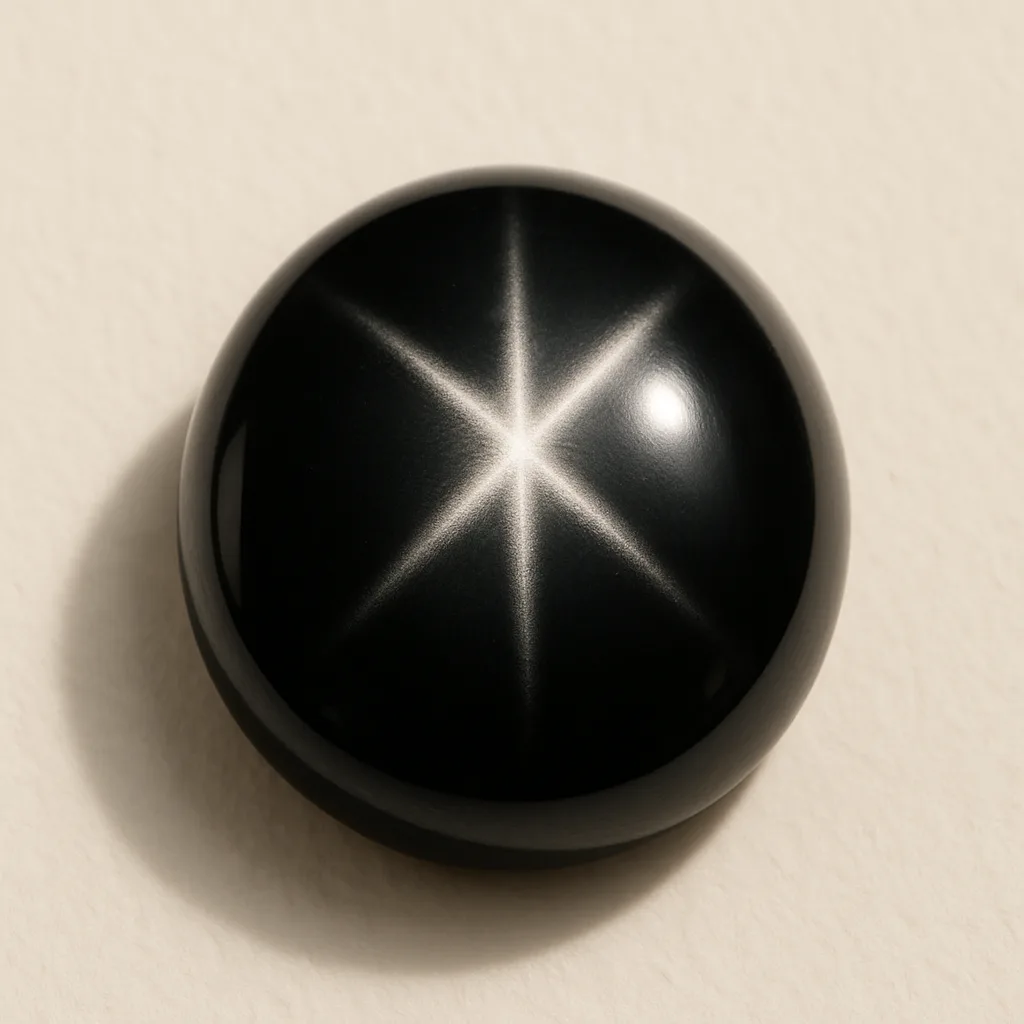
identified this stone yet
Black Star Sapphire
| Hardness | 9 |
| Specific gravity | 4.00 |
| Refractive index | 1.762-1.770 |
| Crystal system | 六方晶系(三方晶系) |
Body color ranges from inky black through blackish green and dark grey. The star rays are silver, golden, or bronze, sometimes with a faint reddish tint where ferric iron predominates.
- nclusions in three directions producing the six-rayed asterism
- Color zoning, particularly visible at the base of the
- nclusions of mica, feldspar, or pyrite in natural stones
- Generally heavily included — opacity is intrinsic to the stone, not a flaw
- Doubly refractive, uniaxial negative
- Refractive index 1.76–1.77 (measurable only on a polished basal , not the dome)
- Specific gravity 3.95–4.05
- Six-rayed asterism — the defining optical feature, sharpest under a single point light source
- 01Six sharp rays with the central star directly above the axis indicate well-oriented natural material
- 02Natural asterism is slightly irregular and soft; Linde synthetic stars are mathematically perfect and often 'too sharp' to be natural
- 03The base of a Linde synthetic often shows a rounded, polished surface; natural material is more commonly flat-bottomed
- 04nclusions visible under fiber-optic lighting are the natural-origin marker
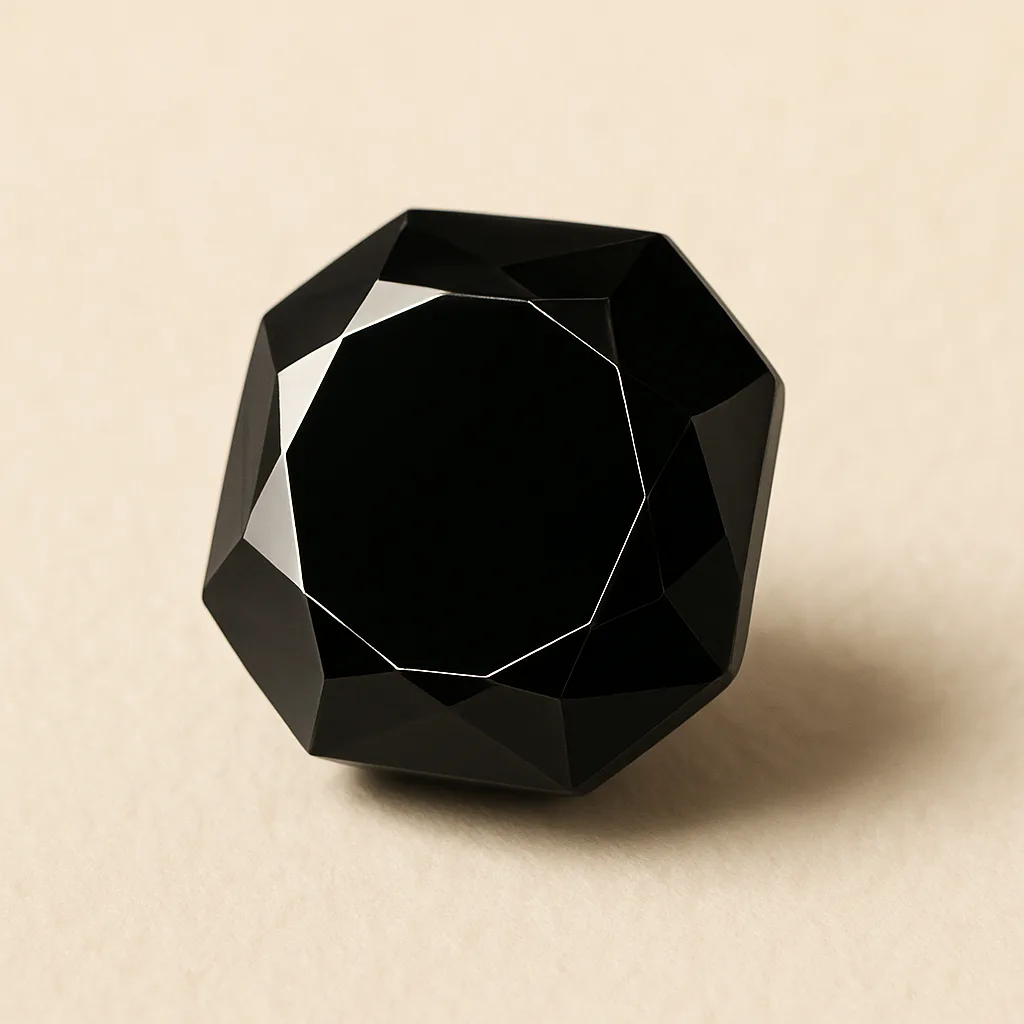
- Mohs 9 — extremely durable; safe for cufflinks, signet rings, and daily wear
- Safe to ultrasonic and steam cleaning
- Stable to all normal jeweler's chemicals
¥3,000–10,000/ct for commercial Thai material up to ¥30,000–50,000/ct for fine well-centered stars above 5 ct. Linde synthetics trade in the ¥1,000–3,000/ct range and are sometimes mistakenly sold as natural — always verify provenance.
Note: Synthetic Linde star sapphire (Verneuil-grown with controlled hematite-needle precipitation) is extremely common and visually convincing; natural-versus-synthetic separation requires careful examination of the dome surface, base finish, and inclusion pattern. Diffusion treatment to create or enhance asterism in low-grade corundum is documented and must be disclosed. A sharp, well-centered, bright silver star on inky black is the quality marker.
Black star sapphire is dark, iron-rich corundum (Al₂O₃) cut as a domed so that microscopic parallel needles of hematite or ilmenite — aligned along the basal plane in three directions 60° apart — reflect light as a sharp six-rayed star. Unlike the nclusions of black star sapphire produce silver, golden, or bronze stars on a near-black ground. Mohs 9, opaque, SG 3.95–4.05.
Origins
Thailand (Kanchanaburi, Chanthaburi) is the historical and still dominant commercial source — Chanthaburi cutters established the modern black star sapphire trade in the early 20th century. Australia (Queensland's central highlands), Montana, Madagascar, and Nigeria contribute additional production. Thai material is prized for the sharpness and brightness of its silver rays on a deep black ground.
History
Thai black star sapphire reached Western markets in the early 20th century and became the canonical stone of mid-20th-century American men's jewelry — cufflinks, tie bars, signet rings, and tuxedo studs. The Linde Air Products Division of Union Carbide perfected synthetic Verneuil black star sapphire in the 1940s and 1950s, branded simply as 'Linde Star,' for the Hollywood market; the 'Santa Maria Star Sapphire' brand appeared in studio publicity photographs of Cary Grant, Bing Crosby, and James Stewart. Black star sapphire reached peak commercial visibility between 1945 and 1965, then declined as men's jewelry styles shifted away from formal accessories.
Lore & symbolism
Folk tradition in Thailand and Sri Lanka attributes protective powers to the three star rays — variously linked to faith, hope, and destiny, or to the three theological virtues of medieval Christianity. The stone is sometimes called the 'stone of destiny' or the 'star of the warrior' in modern marketing copy. There is no significant medieval European lore; the gem entered Western culture only in the 20th century.
Tools to confirm this stone
Tools that help confirm Black Star Sapphire. Tap any item to jump to the matching section on the gem tools page.
- Last reviewed
- April 28, 2026
- Bibliography
- Gem Encyclopedia / GIA (Gemological Institute of America)
- Gem Identification Standards / Central Gem Laboratory (CGL), Tokyo
- Mineral & Gem Database / Mindat.org / Gemdat.org
- Introduction to Gemology / Gemmological Association of All Japan (GAAJ)
The gemological data on this page (refractive index, specific gravity, hardness, crystal system, etc.) is cross-checked against the authoritative primary sources listed above. Values may be revised as gemological research advances.