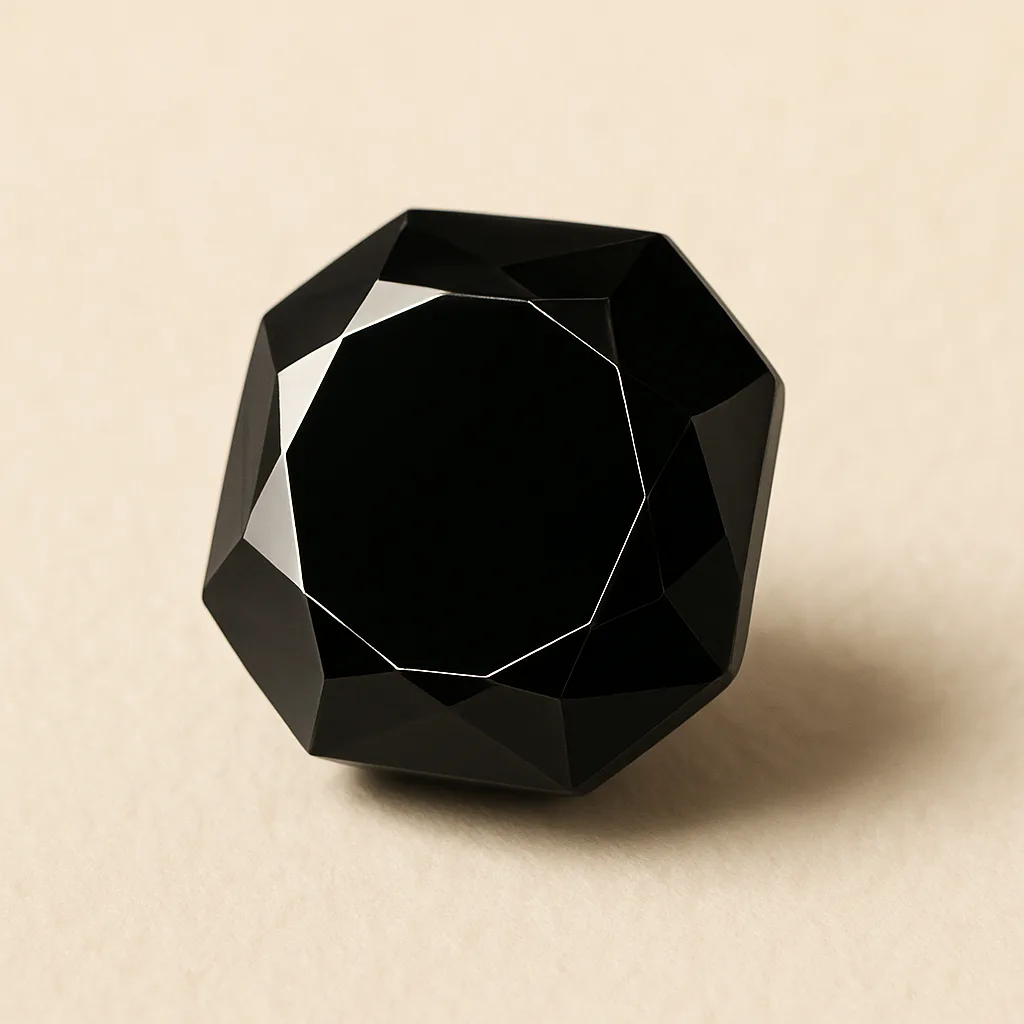
identified this stone yet
Black Spinel
| Hardness | 8 |
| Specific gravity | 3.60 |
| Refractive index | 1.718 |
| Crystal system | 等軸晶系 |
Opaque deep black with high lustre — hexcode #111113 to #1F1F22. The colour is uniform without variation; surface lustre ranges from sub-adamantine to vitreous depending on cut quality. The Thai 'black star spinel' (Chanthaburi 4-rayed asterism material) shows the same deep black body with a silvery-white 4-rayed star asterism on cut.
- nclusions (the chromophore source) — produces the 4-rayed asterism in Thai Chanthaburi material
- egative crystals — diagnostic spinel signature visible only on high-resolution surface imaging due to opacity
- nclusion networks (rare in opaque material)
- nclusions
- Refractive index 1.712–1.736 — singly refractive (where measurable through pinpoint surface contact; the opaque material limits standard refractometer reading)
- Specific gravity 3.58–3.90 — the iron-saturated black material trends higher than other colour varieties
- Mohs 8 — excellent durability
- Opaque (high iron content produces full visible-spectrum absorption)
- Sub-adamantine to vitreous polish lustre
- Inert under both LW and SW UV
- nclusions
- 01Mohs 8 hardness — separates from black tourmaline (Mohs 7) and black obsidian (Mohs 5–5.5) on scratch test
- 02Singly refractive (no ) — separates from black zircon (strong ) and most other black gem materials
- 03Specific gravity 3.58–3.90 — separates from black tourmaline (3.06), black obsidian (2.35–2.55), and black diamond (3.52)
- 04Lack of conchoidal fracture — separates from black obsidian (volcanic glass with characteristic conchoidal fracture)
- 05Lack of striations or columnar structure — separates from black tourmaline (characteristic vertical striations)
- 06High sub-adamantine polish lustre — distinctive of black spinel versus the duller lustre of black onyx (Mohs 7 chalcedony)
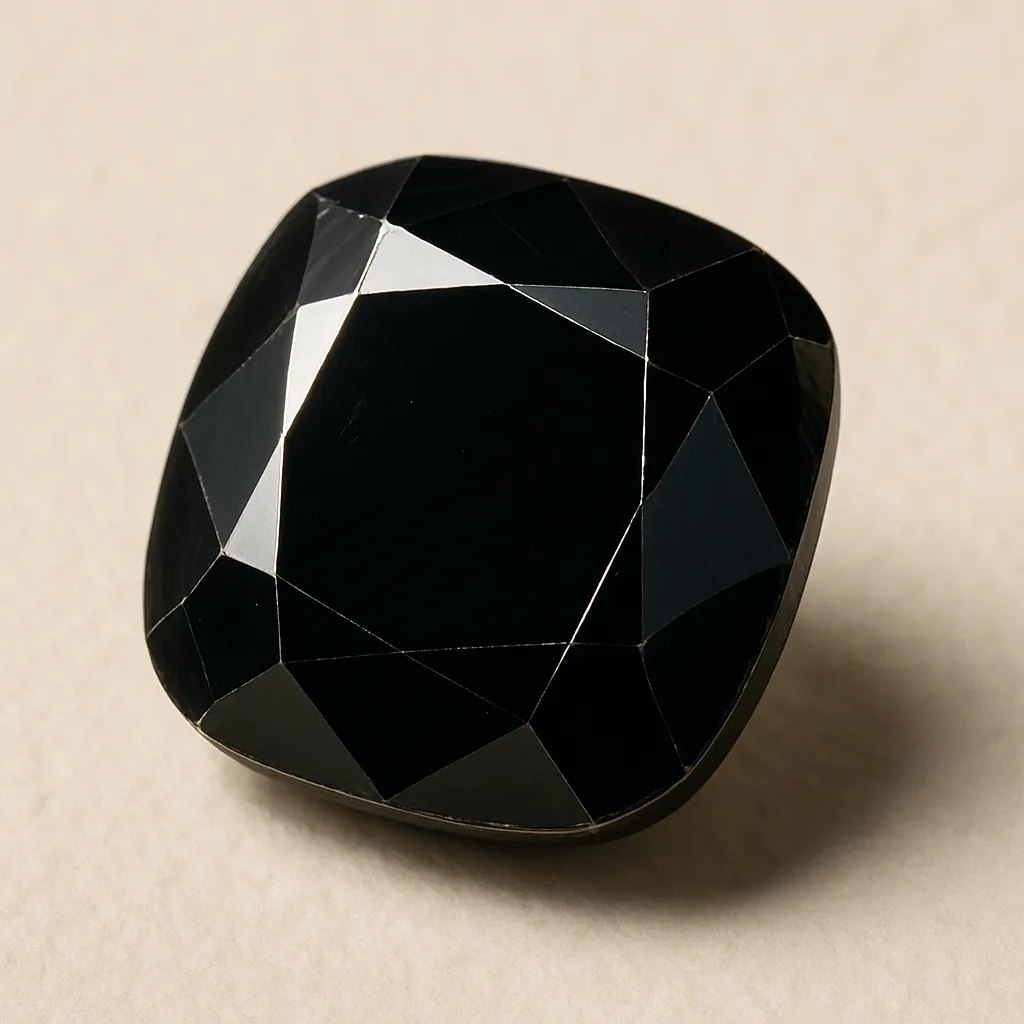
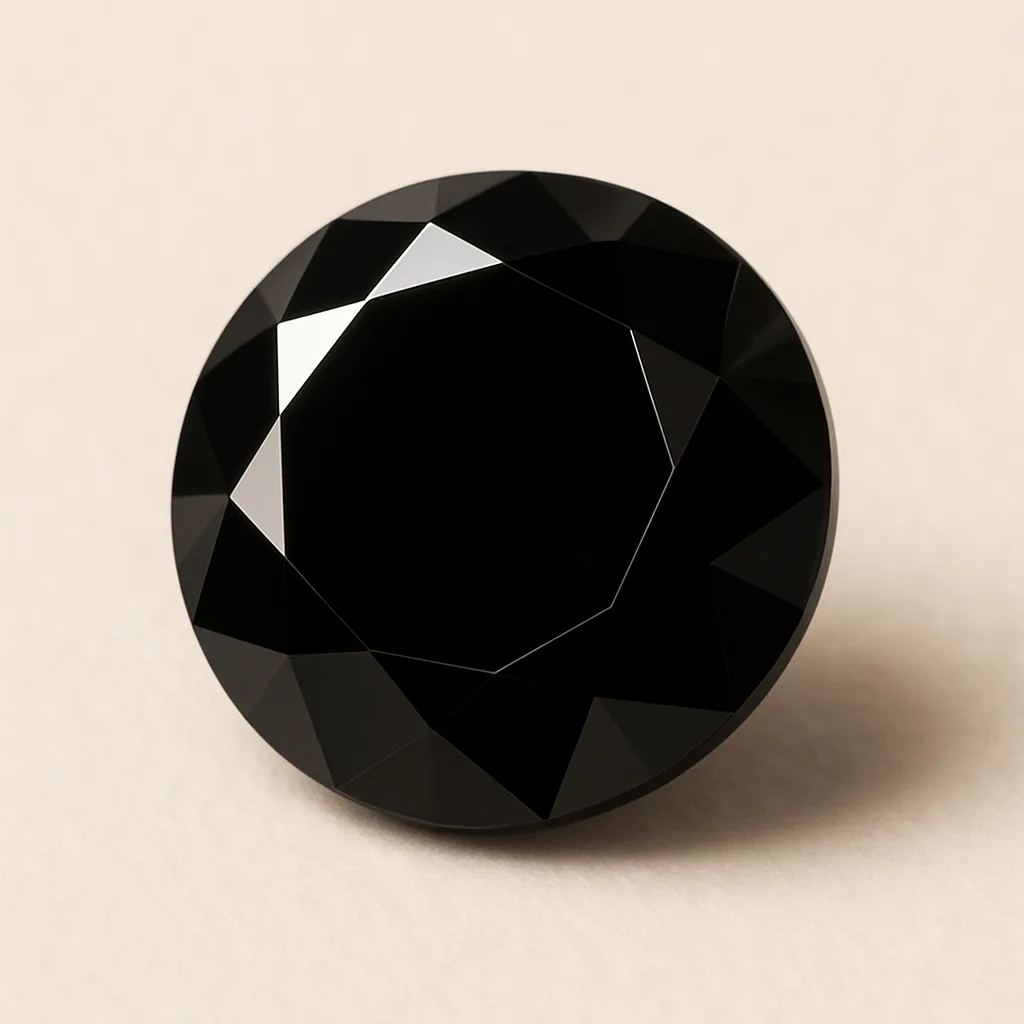
- Mohs 8 — excellent durability for daily wear including ring and bracelet use
- Ultrasonic cleaning generally safe
- Steam cleaning acceptable
- Storage in a soft pouch
Sri Lankan Ratnapura commercial black-spinel faceted stones at $5–$50 per carat for 1–3 carat stones. Thai Chanthaburi material at $10–$80 per carat. Thai 'black star spinel' (4-rayed asterism cabochons) at $50–$500 per carat. Tanzanian Mahenge material at $10–$60 per carat. Mogok Burmese material at $20–$150 per carat. Luxury-house finished jewelry incorporating black-spinel pavé (Chanel Café Society pieces, Cartier black-spinel pavé bracelets) trades at $5,000–$100,000+ per piece, but the black-spinel content represents only a small fraction of the price compared with the design, gold/platinum work, and brand premium.
Note: Disclosure as 'natural spinel' or 'black spinel' is the trade standard; heat treatment is not typically applied to black material (the iron chromophore is already saturating). Disclosure as 'star spinel' for the Thai Chanthaburi 4-rayed asterism material. The major luxury-house adoption (Chanel, Cartier, Tiffany, David Yurman, Lorraine Schwartz) drives premium positioning for branded pavé jewelry while the commercial loose-stone market remains accessible. Origin documentation is rarely required for black-spinel jewelry given the low per-carat pricing.
Black spinel is MgAl₂O₄ in the cubic isometric system, coloured by saturating Fe²⁺ and Fe³⁺ (typically 5–15 wt% FeO+Fe₂O₃ — the high iron content makes the term 'ceylonite' or 'pleonast' historically applicable for iron-saturated spinel varieties). The opaque deep black colour with high lustre and the Mohs 8 hardness combine to produce a gem material that competes effectively with black diamond for pavé and central-stone use in fine jewelry — at dramatically lower cost. The singly-refractive isotropic-cubic structure produces uniform reflection without or aceting capacity scaled substantially from the early 2000s as luxury houses adopted the material; Chanel's 2003 Café Society high-jewelry collection (Patrice Leguéreau atelier, 18 Place Vendôme) is a landmark commercial use.
Origins
aceted-stone market.
History
Black spinel appears in classical Indian gemological tradition — the Sanskrit 'Ratna-Pariksha' (Buddhabhatta c. 6th century CE) mentions it as a protective amulet stone and seal-engraving material under the term 'sphatika-mani.' The Mughal seal-engraving tradition (16th–18th century, the Imperial workshops at Agra, Delhi, and Lahore) used black spinel alongside red and pink spinel for inscribed signet rings and stamp seals. The medieval and Renaissance European trade incorporated some black spinel under the broader 'pleonast' or 'ceylonite' iron-rich spinel category without distinguishing it commercially from red and pink varieties. Mineralogical classification: the term 'pleonaste' was coined by René Just Haüy in his 1801 'Traité de Minéralogie' for the iron-aluminate spinel (Mg,Fe)Al₂O₄ end-member; the term 'ceylonite' references Sri Lankan provenance for iron-rich black spinel. The breakthrough modern commercial era began in 2003 when Chanel's Café Society high-jewelry collection (Patrice Leguéreau atelier at 18 Place Vendôme) prominently featured black-spinel pavé and central stones, establishing the precedent for luxury-brand adoption. Cartier, Tiffany & Co., David Yurman, Lorraine Schwartz, and other major houses followed through the mid-2000s and 2010s. The 2010s 'minimalist black gem' engagement-ring trend (parallel to the salt-and-pepper diamond and black diamond trends) further consolidated the commercial position. The 2016 AGTA addition of spinel as August birthstone covered all colour varieties including black.
Lore & symbolism
August birthstone since 2016 (AGTA addition). The classical Sanskrit 'Ratna-Pariksha' tradition (Buddhabhatta c. 6th century CE) treats black spinel as a protective amulet and 'evil-eye' deflector — the Mughal seal-engraving tradition extended this protective association. Modern metaphysical traditions (Melody 1995, Hall 2003) place black spinel on the root chakra for grounding, protection, and 'shadow work' psychological integration. The Chanel 2003 Café Society high-jewelry collection narrative gives the variety a luxury-fashion-history association with Coco Chanel's signature black-and-white aesthetic.
Tools to confirm this stone
Tools that help confirm Black Spinel. Tap any item to jump to the matching section on the gem tools page.
- 最終確認日
- 2026年4月28日
- 参 考 文 献
- Gem Encyclopedia/ GIA (Gemological Institute of America)
- 宝石鑑別基準/ 中央宝石研究所 (CGL)
- Mineral & Gem Database/ Mindat.org / Gemdat.org
- 宝石学入門/ 全国宝石学協会
本ページの物性値(屈折率・比重・硬度・結晶系等)は、上記の権威ある一次資料を相互参照して編集しています。最新の鑑別研究の進展により値が更新される場合があります。