identified this stone yet
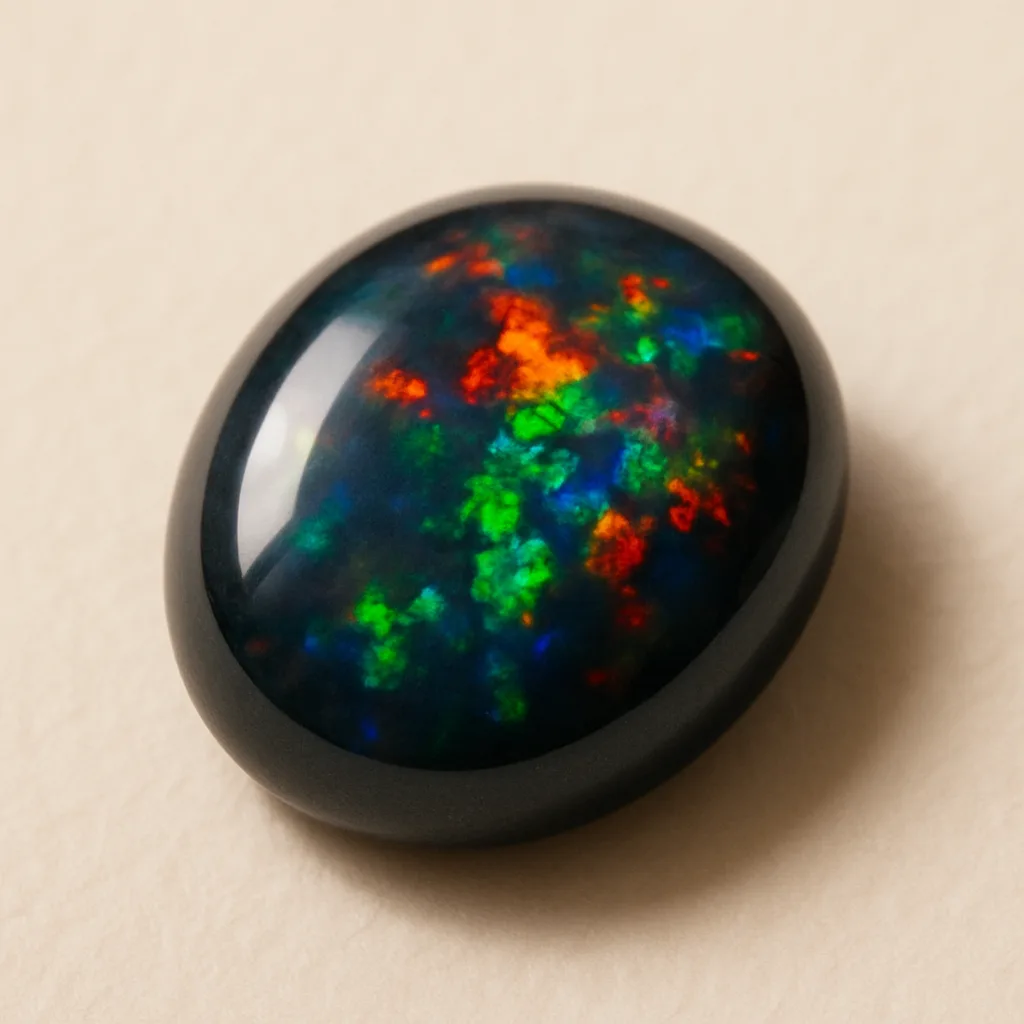
Black Opal
| Hardness | 5.5-6 |
| Specific gravity | 1.98-2.20 |
| Refractive index | 1.37-1.47 |
| Crystal system | 非晶質(含水シリカ) |
Body tones N1–N4 on the GIA black opal scale (pure black to dark gray) with play-of-color in red, orange, green, blue, and violet. Red-on-black is the most valuable pattern.
- Iron oxide or carbon staining (the source of the dark body)
- nclusions in boulder-style material
- Crazing (fine surface cracks) in unstable material
- Internal cracks visible at 10× — significant value impact
- Singly refractive (amorphous)
- No — but striking play-of-color diffraction
- 01Solid opal has no glue line visible at the girdle when viewed from the side
- 02Doublets and triplets show a flat glue line; triplets show a clear domed cap
- 03Australian solid black opal is almost always stable; Ethiopian black opal may absorb water and lose play-of-color when wet — never test by immersion without consent
- 04Synthetic opal (Gilson, Kyocera) shows a 'lizard skin' columnar pattern at the top of each color patch under 10×
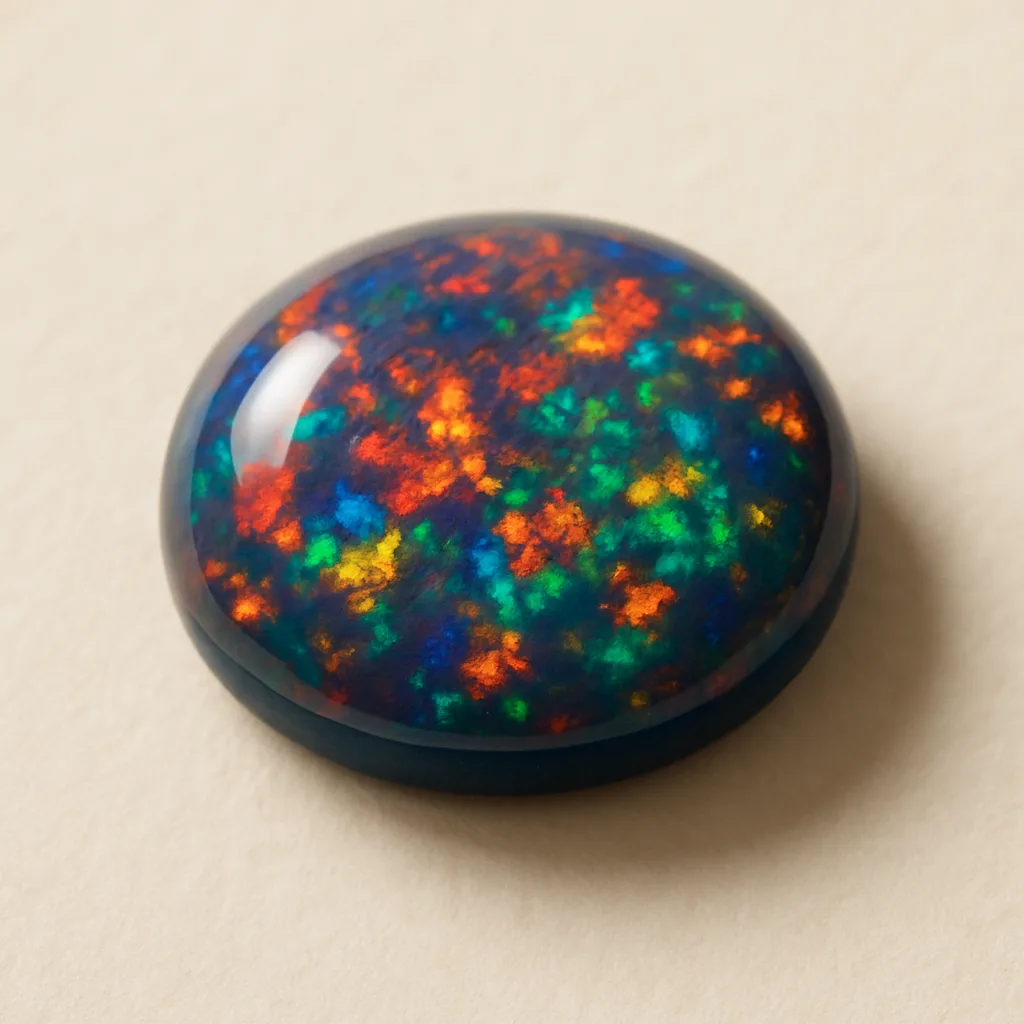
- Avoid ultrasonic, steam, and prolonged immersion — opal contains 5–10% water and reacts to thermal/humidity shifts
- Avoid impacts — Mohs 5.5–6.5 and brittle
- Store at moderate humidity; do not place near desiccants or in unconditioned safes for extended periods
From $200/ct for commercial body-tone N4 stones up to $20,000+/ct for top red-on-black Lightning Ridge material.
Note: Body tone (N1–N4 for black opal), play-of-color brightness, pattern, and direction of view all affect value dramatically. Solid black opal is far more valuable than doublets (opal slice cemented to a black backing) or triplets (opal slice between black backing and clear cap). Always verify solid vs. assembled.
nclusions of iron oxide or carbon set against the silica matrix produce the dark body tone that intensifies the color flashes. Mohs 5.5–6.5 with significant water content makes opal both vulnerable to dehydration and to impact.
Origins
Lightning Ridge in New South Wales, Australia produces nearly all true black opal. Nearby fields (Coober Pedy, Mintabie) yield mostly white and crystal opal. Welo (Ethiopia) produces some dark-body opal often called 'Ethiopian black opal,' but its hydrophane nature (absorbs water) and instability separate it from Lightning Ridge material in the trade.
History
Lightning Ridge black opal was discovered in 1903, transforming opal from a romantic European stone into the iconic Australian gem. The 'Aurora Australis' (180 ct, found in 1938) and 'Black Prince' are among the most famous specimens, valued in the millions.
Lore & symbolism
October's birthstone (alongside tourmaline). Historically symbolic of hope, but also associated with bad luck after Sir Walter Scott's 1829 novel Anne of Geierstein — a superstition the trade has spent two centuries undoing.
Tools to confirm this stone
Tools that help confirm Black Opal. Tap any item to jump to the matching section on the gem tools page.
- Last reviewed
- April 28, 2026
- Bibliography
- Gem Encyclopedia / GIA (Gemological Institute of America)
- Gem Identification Standards / Central Gem Laboratory (CGL), Tokyo
- Mineral & Gem Database / Mindat.org / Gemdat.org
- Introduction to Gemology / Gemmological Association of All Japan (GAAJ)
The gemological data on this page (refractive index, specific gravity, hardness, crystal system, etc.) is cross-checked against the authoritative primary sources listed above. Values may be revised as gemological research advances.