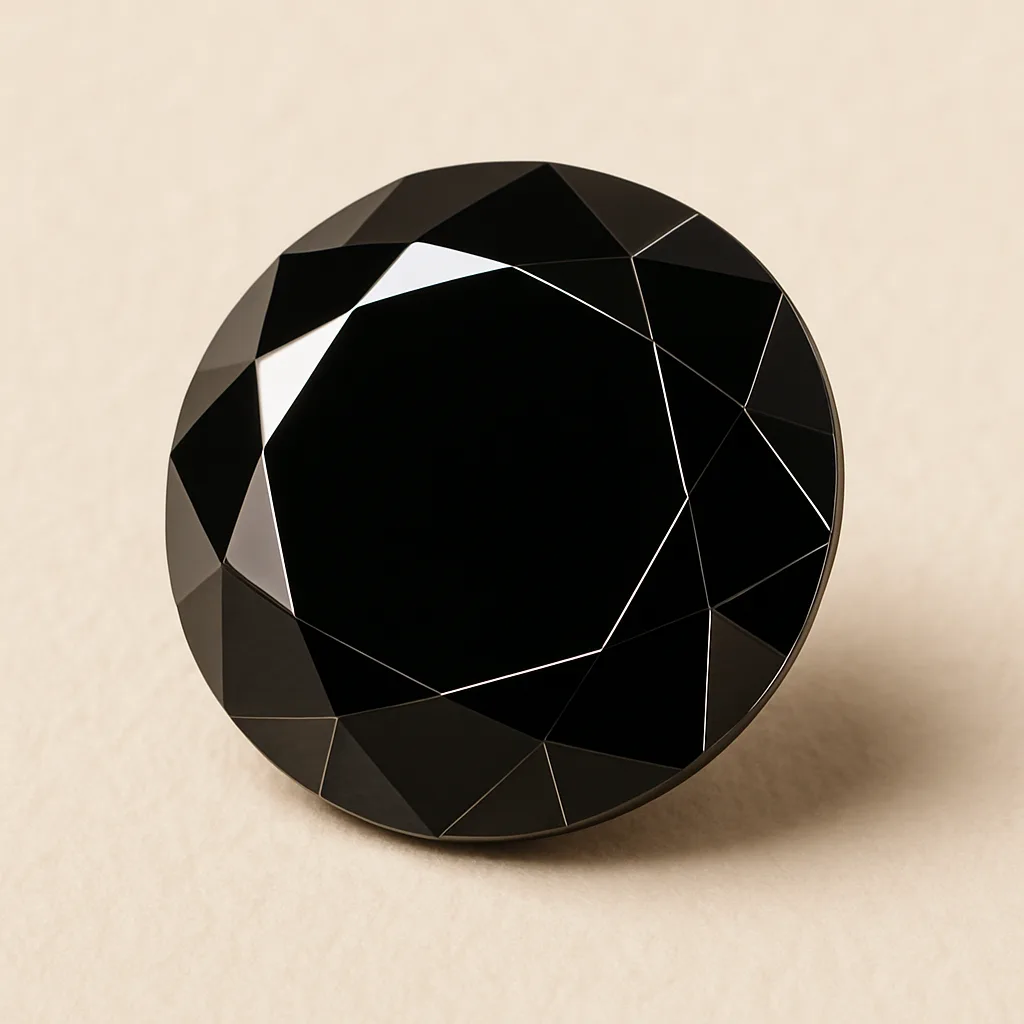
identified this stone yet
Black Glass
| Hardness | 5-6 |
| Specific gravity | 2.3-4.5 |
| Refractive index | 1.44-1.70 |
| Crystal system | 非晶質(アモルファス) |
Opaque jet-black, sometimes with a faint blue-green or olive cast depending on the iron-to-manganese ratio in the glass batch. The deepest blacks combine FeO/Fe₂O₃ with MnO₂ in a 1:1 to 2:1 ratio; the manganese contribution suppresses the iron green and pulls the tone toward neutral black. Some Czech material shows weak surface iridescence ('Aurora Borealis' Swarovski-style coatings post-1908) or metallic-lustre flashes from copper or aluminum reduction.
- Regular round gas bubbles distributed evenly through the glass matrix — diagnostic of molded or pressed glass at 10×
- Surface molding seams and parting lines from the press-die manufacturing process
- Swirl flow lines from the molten-glass injection — distinct from the natural flow banding in obsidian, which is irregular
- Devitrification crystallites in older or heat-stressed material
- Occasional foreign particles from the glass batch (refractory grains, undissolved feedstock)
- Singly refractive (amorphous glass structure) — no at any orientation
- Refractive index 1.44–1.70 depending on lead content (Strass paste typically 1.55–1.65, Bohemian crystal 1.50–1.55, soda-lime 1.44–1.52)
- Specific gravity 2.3–4.5 — lead-crystal black glass at the high end (Mohr's lead-content correlation)
- Mohs 5–6 — softer than most natural gems, easily scratched by quartz (Mohs 7)
- Conchoidal fracture — characteristic curved breakage surface diagnostic of amorphous materials
- 01Regular round gas bubbles visible at 10× immediately diagnose molded glass — natural jet (gagates), obsidian, and onyx never show this signature
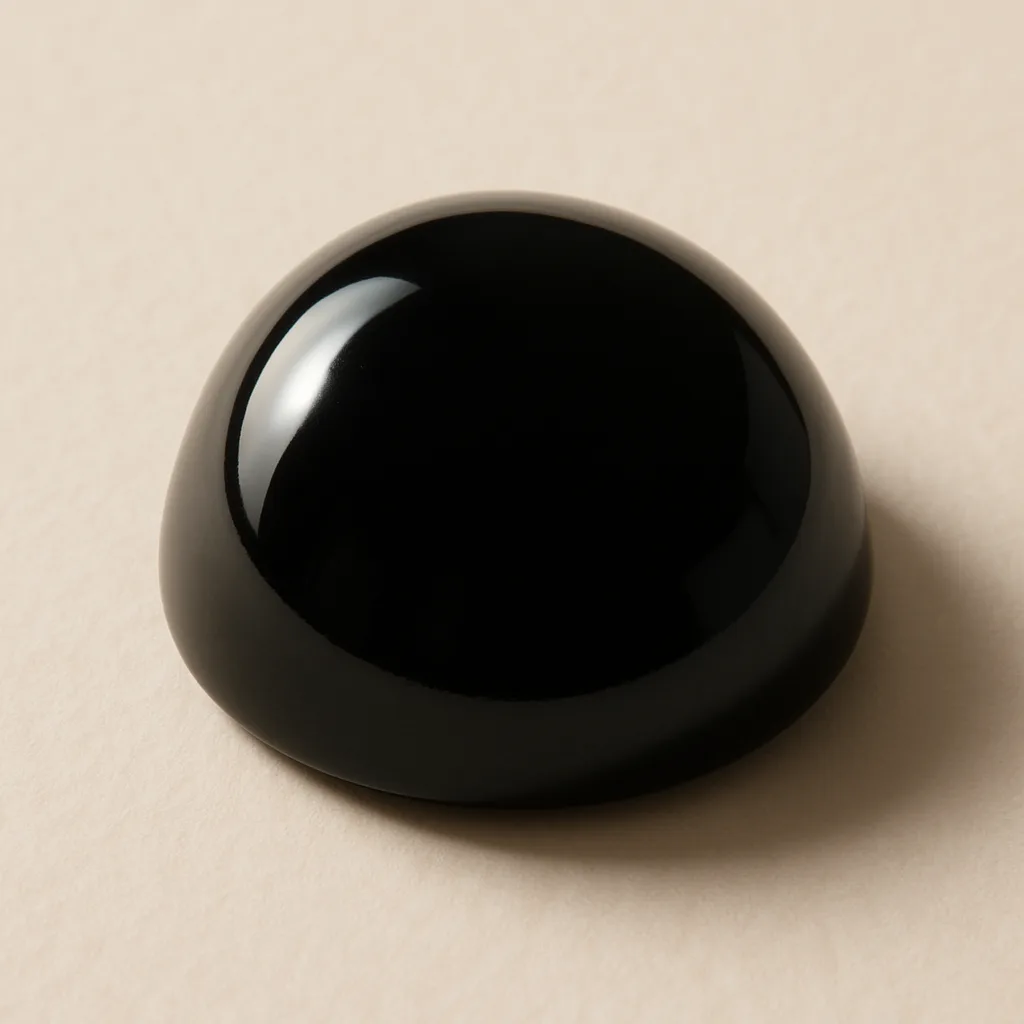
- 02abochons
- 03Mohs 5–6 — easily scratched by quartz (Mohs 7); natural obsidian is Mohs 5.0–5.5 (similar) but shows irregular flow lines rather than regular bubbles
- 04Warm to touch (low thermal conductivity) like jet but unlike obsidian
- 05No magnetic response (distinguishes from hematite-based imitations)
- 06Density check: lead-crystal black glass reads heavier in hand than jet (jet SG ~1.3); soda-lime black glass reads similar to onyx
- Mohs 5–6 — stores separately to avoid scratches from quartz, garnet, or harder gems
- Avoid ultrasonic cleaning — vibration can crack the brittle glass matrix
- Stable to light and standard mild detergent; warm soapy water and soft brush
- Avoid thermal shock (rapid temperature changes) — conchoidal fracture risk
- Avoid contact with strong acids and bases — surface etching possible
Modern molded cabochons and faceted rounds trade at $0.10–$2.00 per piece wholesale at the bead-jewelry level; quality Czech Gablonzer pressed-glass beads in larger sizes (12–18 mm) command $3–$15 per piece. Genuine antique Victorian French-jet jewelry (1860–1910 documented provenance) trades at $50–$800 per piece at vintage and estate auctions; museum-quality whole-suite mourning jewelry sets with documented provenance to royal or aristocratic families can reach $5,000–$25,000 at major auctions. The 100-to-1,000× price differential between modern bulk material and provenanced Victorian pieces drives the importance of accurate dating and material identification in the antique trade.
Note: Disclosure as 'glass' or 'imitation jet' is mandatory under FTC Jewelry Guides §23.25 and CIBJO Blue Book rules — the trade names 'French jet' and 'Vauxhall jet' are tolerated in antique and vintage trade contexts but require explicit material disclosure in modern retail. Genuine Victorian-era French jet retains collector value as period costume jewelry; modern reproductions trade as bulk costume material. The Bohemian Gablonzer designation has been recognized as a protected origin label by the EU since 2010 for high-quality pressed-glass beads. Beware of dyed black onyx and reconstituted obsidian marketed as 'natural black stones' — the molded surface seams and regular gas-bubble distribution diagnose the glass origin immediately at 10×.
aceted rounds, and pressed-glass beads dominate the trade; surface molding seams and regular gas bubbles distinguish the material from natural jet (Whitby gagates) and obsidian.
Origins
Czech Republic (Jablonec nad Nisou — historically Gablonz an der Neisse, the dominant nineteenth- and twentieth-century European glass-jewelry industrial centre, locally called Gablonzer Industrie) is the principal historical source; the Bohemian works exported black-glass mourning components worldwide from 1860 through the 1920s. France (Saint-Gobain and the Paris paste workshops descended from Georg Friedrich Strass's 1730s atelier) produced the bulk of the 'French jet' beads that gave the substitute its common trade name. England (Birmingham and Stourbridge glassworks) supplied the domestic British mourning market alongside imports. Twentieth-century production shifted to India (Firozabad glass bangle district) and China (Shandong and Hebei pressed-glass factories) for the costume-jewelry mass market. Murano (Venice) produced higher-grade black lampwork beads in the millefiori and aventurine traditions; the Bohemian seed beads remain the standard for embroidery and bead-weaving applications.
History
Roman black glass (vitrum nigrum) was produced at Pompeii and Herculaneum in the first century CE — Pliny's Naturalis Historia Book 36 (chapters 65–67, c. 77 CE) describes glass-coloring techniques including the addition of iron and manganese for dark tones. Medieval Venetian cristallo (Angelo Barovier's 1450s breakthrough) established the Murano leaded-glass tradition. Georg Friedrich Strass (1701–1773), a Strasbourg-born Parisian jeweller, perfected leaded-paste imitation gemstones in the 1730s and was named jeweller to King Louis XV in 1734 — the resulting 'Strass paste' became the standard high-quality glass-imitation material, and the word 'rhinestone' (originally from quartz pebbles collected along the Rhine) was redirected to mean Strass-style paste from the late eighteenth century onward. Prince Albert's death on 14 December 1861 launched Queen Victoria's forty-year mourning, which established black-jewelry etiquette across Britain and the Empire; Cassell's Household Guide (1869) codified the rules. Whitby jet (gagates from the Yorkshire coast, Toarcian Jurassic c. 182 Ma) was the prestige material, but black glass — locally produced or imported from Bohemia and France as 'French jet' — supplied the broader mass market. Daniel Swarovski's 1892 founding of his Wattens (Tyrol, Austria) cut-glass factory and his 1908 Aurora Borealis iridescent coating (later partnered with Christian Dior's 1955 New Look revival) extended the black-paste tradition into modern costume jewelry. The 1968 US FTC Jewelry Guides §23.25 ruling formalized disclosure rules requiring the term 'glass' or 'imitation X' rather than the species name for misleading trade descriptions.
Lore & symbolism
No birthstone designation (synthetic/imitation material). Historically the dominant symbol of Victorian mourning culture, with mass-market 'French jet' supplying widows, family members, and even servants in proper mourning observance from the 1860s through the Edwardian period. Cassell's Household Guide (1869) and Sylvia's Home Journal etiquette columns codified the wear-rotation from heavy mourning (year one) to half-mourning (year three onward), with black jet or black glass mandatory throughout. Modern crystal-writing assigns no specific spiritual properties to glass imitations, though contemporary goth and revival subcultures continue to value French jet aesthetics. The historical narrative of accessibility — black glass democratized mourning observance for working-class Victorians who could not afford genuine Whitby jet — gives the material a documented cultural significance disproportionate to its modern gem-trade status.
Tools to confirm this stone
Tools that help confirm Black Glass. Tap any item to jump to the matching section on the gem tools page.
- 最終確認日
- 2026年4月28日
- 参 考 文 献
- Gem Encyclopedia/ GIA (Gemological Institute of America)
- 宝石鑑別基準/ 中央宝石研究所 (CGL)
- Mineral & Gem Database/ Mindat.org / Gemdat.org
- 宝石学入門/ 全国宝石学協会
本ページの物性値(屈折率・比重・硬度・結晶系等)は、上記の権威ある一次資料を相互参照して編集しています。最新の鑑別研究の進展により値が更新される場合があります。