identified this stone yet
Andalusite
| Hardness | 7.5 |
| Specific gravity | 3.13-3.21 |
| Refractive index | 1.629-1.650 |
| Crystal system | 斜方晶系 |
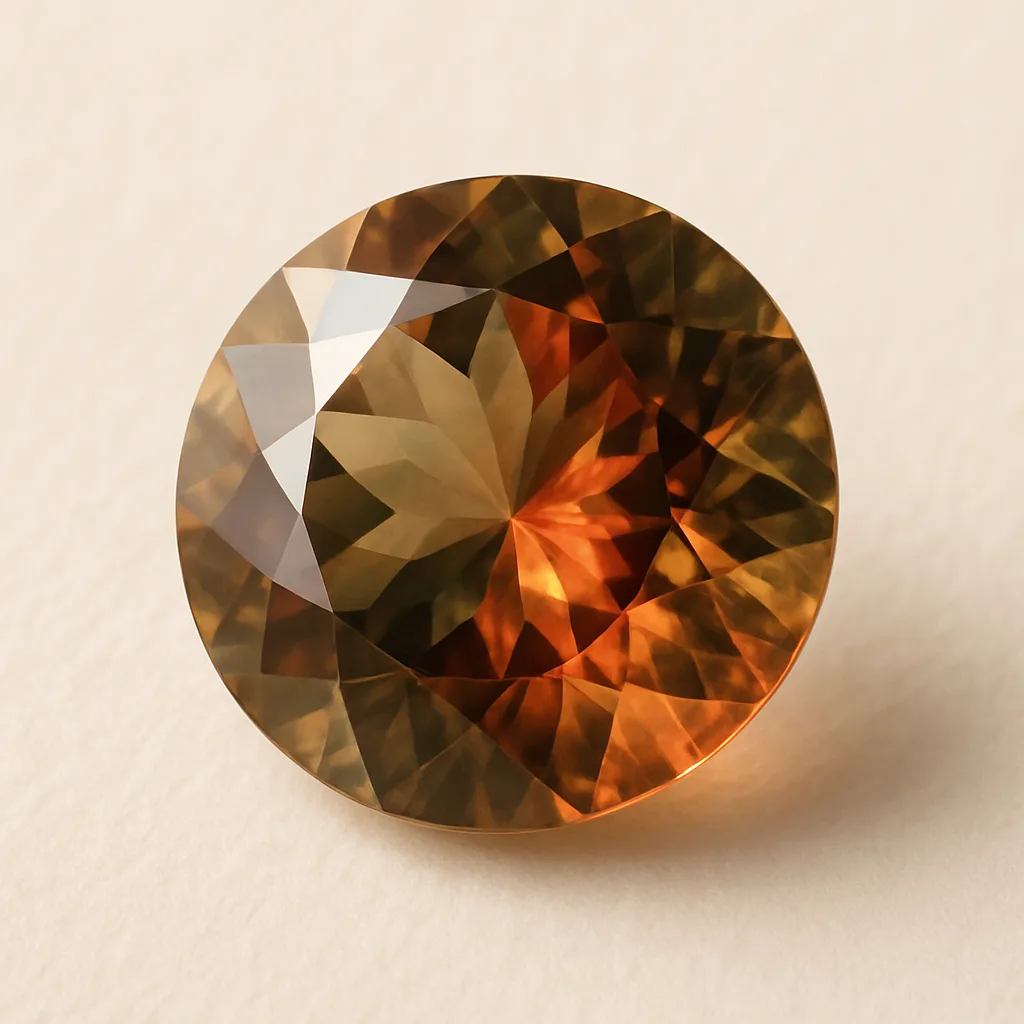
Yellow-green and olive-green base color with red-orange to brown flashes from . Iron, manganese, and titanium are the principal chromophores.
- nclusions (the polymorphic relative)
- Biotite mica flakes
- Liquid-filled feathers and healed fractures
- nclusions in chiastolite variety — diagnostic of high-temperature crystallization
- Doubly refractive, biaxial negative
- Refractive index 1.629–1.650
- 0.011
- Strong trichroic — green, red-orange, and yellow-brown along the three optical directions
- Specific gravity 3.13–3.21
- 01Three-color (red-orange / yellow-brown / olive-green) visible without a dichroscope by simple rotation — diagnostic and immediate
- 02Refractive index 1.63–1.65 with biaxial optic figure separates from corundum (uniaxial, RI 1.76+) and tourmaline (uniaxial, RI 1.62–1.64)
- 03Specific gravity 3.15 separates from topaz (3.5), tourmaline (3.04–3.10), and titanite/sphene (3.5)
- 04Inert to UV and Chelsea filter — separates from chromium-bearing pleochroic stones
- Mohs 7–7.5 — durable enough for daily wear in protective settings
- Distinct in two directions — avoid hard knocks on the plane
- nclusions
Several thousand to twenty thousand yen per carat for typical commercial material up to several tens of thousands of yen per carat for well-oriented Brazilian stones above 2 ct with strong three-color play.
Note: No treatments are recognized for gem andalusite — the stone is sold as-found and the pleochroism is a natural and unalterable property. Cutting orientation is the principal value driver: a well-oriented stone shows all three pleochroic colors in the face-up view, while a poorly oriented stone shows only one and looks dull.
Andalusite is aluminum silicate (Al₂SiO₅), one of three polymorphs of the same formula along with kyanite and sillimanite. The species was named in 1789 by Jean-Claude Delamétherie after specimens from El Cardoso de la Sierra in Spanish Andalusia, although those original samples were later shown to be a different mineral and the type locality was effectively transferred to Brazil. Gem andalusite is treasured for its strong biaxial — green, red-orange, and yellow-brown all visible in different crystallographic directions — which produces a multicolored play as the cut stone is rotated, distinct from the bicolor alexandrite color change. Cut design is the cutter's central challenge: the orientation of the rough determines which color combination dominates in the face-up view.
Origins
Brazil (Minas Gerais — Vitória da Conquista, Santa Teresa in Espírito Santo) is the dominant modern source, producing 1–5 ct stones with strong three-color nclusions, comes from these and is cut as a curiosity.
History
Andalusite was described by Delamétherie in 1789, with the type locality given as El Cardoso de la Sierra in the Sierra de Guadarrama of Spain (later research showed these were micaceous pseudomorphs, but the name persisted). Gemological interest began in the 19th century with Brazilian Minas Gerais production, but the species remained a connoisseur stone outside the major gem trade for most of the 20th century. The 1970s discovery of larger and cleaner Brazilian rough drove a modest commercial revival, and the stone is now stocked by gem dealers as a budget alternative to alexandrite for buyers who appreciate optical phenomena.
Lore & symbolism
Andalusite has no traditional birthstone or zodiac association — its modern lore is built around the chiastolite cross-stone, which has been used as a Christian protective amulet since the medieval period. The variety with the diagnostic graphite cross is mined in Boyacá, Colombia and in the Lukmanier Pass of Switzerland and is sold to pilgrims at Santiago de Compostela as 'cross stone.'
Tools to confirm this stone
Tools that help confirm Andalusite. Tap any item to jump to the matching section on the gem tools page.
- 最終確認日
- 2026年4月28日
- 参 考 文 献
- Gem Encyclopedia/ GIA (Gemological Institute of America)
- 宝石鑑別基準/ 中央宝石研究所 (CGL)
- Mineral & Gem Database/ Mindat.org / Gemdat.org
- 宝石学入門/ 全国宝石学協会
本ページの物性値(屈折率・比重・硬度・結晶系等)は、上記の権威ある一次資料を相互参照して編集しています。最新の鑑別研究の進展により値が更新される場合があります。