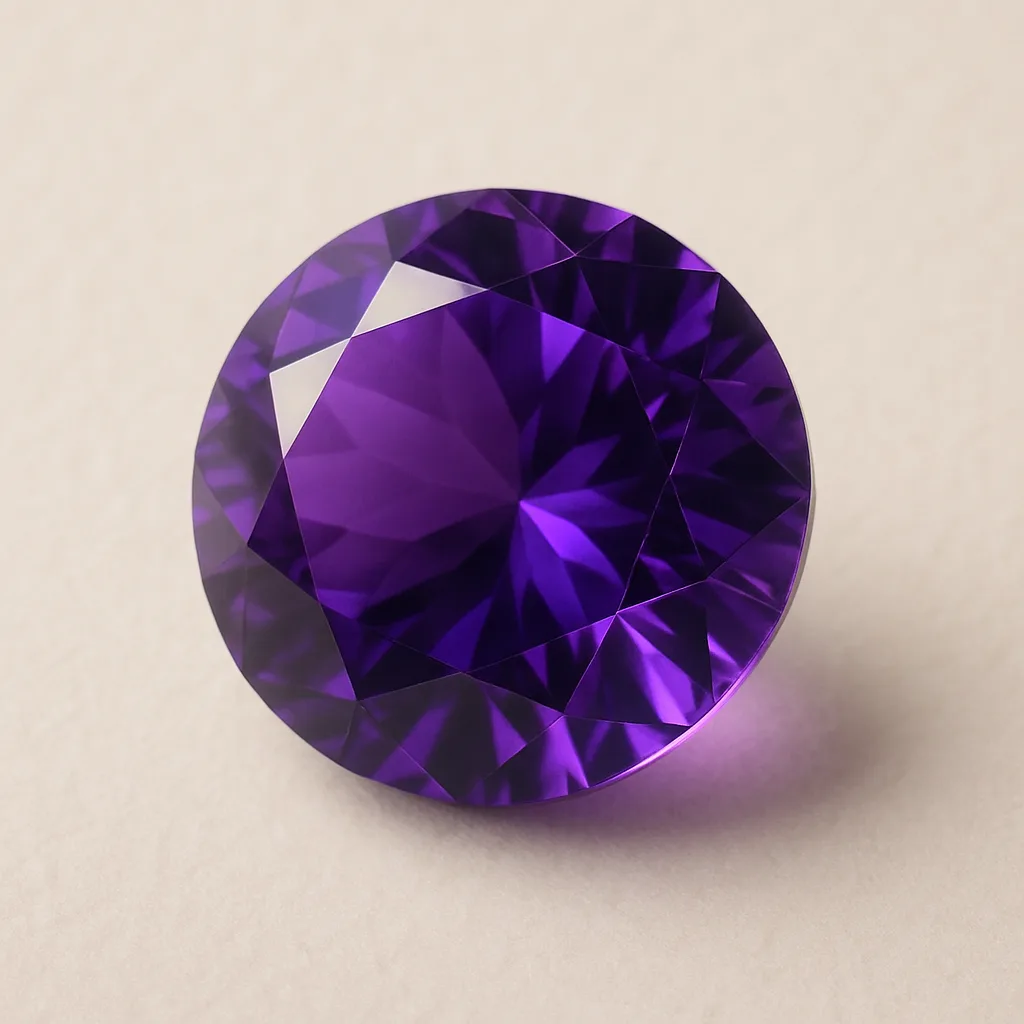
identified this stone yet
Synthetic Amethyst
| Hardness | 7 |
| Specific gravity | 2.65 |
| Refractive index | 1.544-1.553 |
| Crystal system | 六方晶系(三方晶系) |
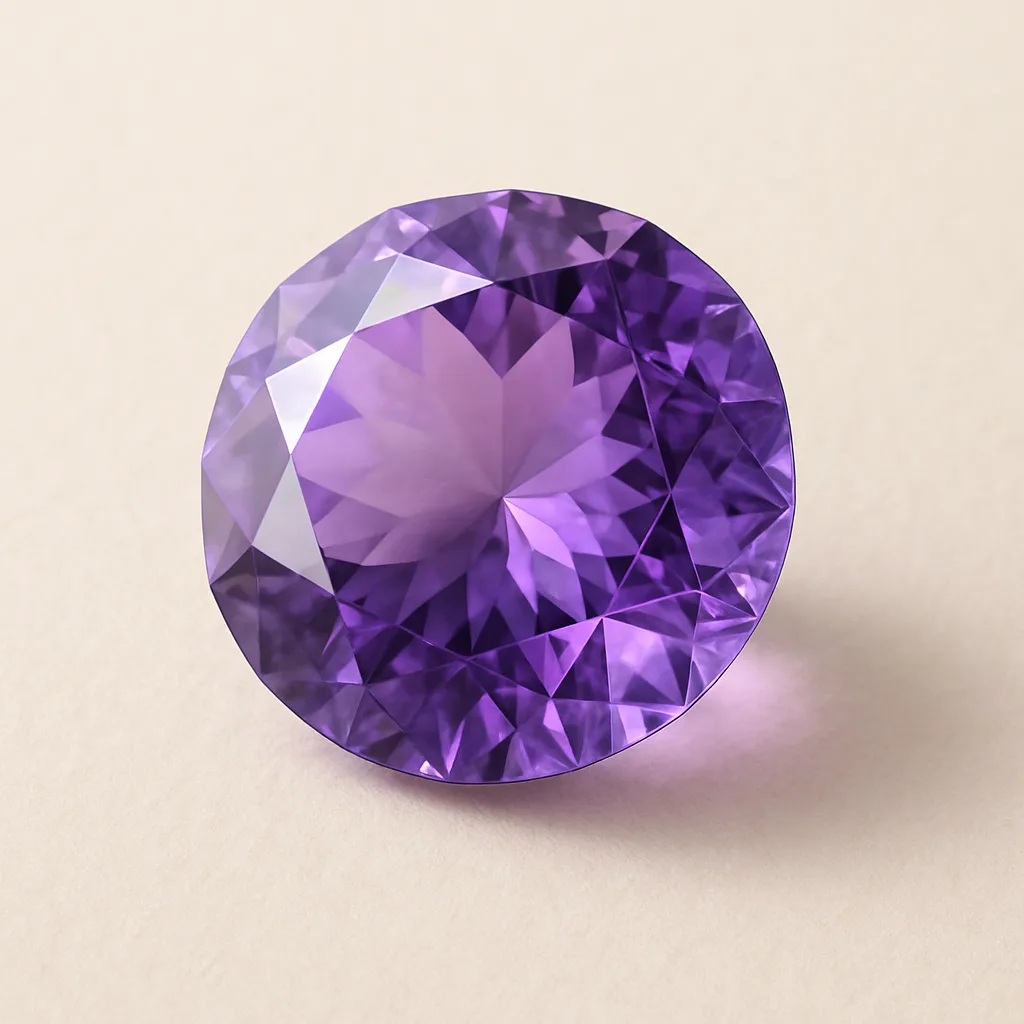
Light purple, medium purple, deep purple, and reddish-purple ('Siberian amethyst') tones. Modern hydrothermal synthetic is produced in pre-selected color saturation matching commercial demand — typically more uniform than natural Brazilian or Uruguayan material of equivalent grade. The deepest 'Russian Siberian'-style purple is consistently available in synthetic; comparable natural deep-purple material from Anahí or Marabá is comparatively scarce.
- Smooth curved growth striae ('seed-plate' residue) from hydrothermal autoclave growth
- Seed-crystal slab residue visible as a faint plane through the center of the rough
- Trigons or chevron growth patterns at 30× immersion in some material
- Notably cleaner and more even color than natural amethyst of comparable grade
- Absence of 'tiger-stripe' Brazil-law twinning zoning characteristic of natural Brazilian and Uruguayan material
- Doubly refractive (uniaxial positive) — identical to natural amethyst
- Refractive index 1.544–1.553, ~0.009
- Vitreous luster
- Weak (purple to bluish-purple)
- 01Smooth seed-plate growth striae visible at 30× immersion — the diagnostic feature of hydrothermal synthetic
- 02Absence of natural color zoning ('tiger stripes,' angular Brazil-law twinning bands) in cut stones
- 03FTIR spectroscopy detects characteristic 3585 cm⁻¹ and 3543 cm⁻¹ water-related absorption bands in hydrothermal synthetic (the Schmetzer 2002 protocol)
- 04Extremely uniform deep 'Russian Siberian' color in a stone above 10 ct trading below $30/ct is a synthetic warning sign
- 05GIA, SSEF, and Gübelin all offer natural/synthetic origin determination
- Mohs 7 — durable but susceptible to scratching by harder gem material
- Avoid prolonged direct sunlight — both natural and synthetic amethyst can fade to colorless or yellow ('burnt amethyst')
- Ultrasonic and steam cleaning are generally safe
- Standard cleaning chemicals (mild detergent, warm water) are acceptable; avoid prolonged exposure to strong acids or alkalis
$1–$15/ct for commercial hydrothermal synthetic amethyst in standard sizes; $20–$50/ct for fine 'Siberian'-tone synthetic material above 5 ct. Natural commercial-grade Brazilian or Uruguayan amethyst runs roughly the same or slightly higher; fine natural Russian Siberian-tone material can reach $200–$500/ct in clean stones above 5 ct, while the very best natural Anahí or fine Marabá material with strong saturation and clarity above 10 ct trades at $500–$1,500/ct.
Note: The dominant economic fact of the amethyst trade is the prevalence of undisclosed synthetic material. Auction houses and major retailers increasingly require lab reports for amethyst above commercial sizes; smaller retailers and online sellers frequently do not. FTC Jewelry Guides, CIBJO Blue Book, and JIS Z 9529 require disclosure of 'synthetic,' 'lab-grown,' or 'created' status, but retail-level enforcement is uneven. SSEF, Gübelin, and GIA all offer amethyst natural/synthetic origin determination, primarily via FTIR detection of characteristic 3585 cm⁻¹ and 3543 cm⁻¹ water bands in hydrothermal material. The Schmetzer 2002 reference protocol remains the basis of modern lab-grade discrimination.
Synthetic amethyst is α-quartz (trigonal, SiO₂) with substitutional Fe³⁺ in tetrahedral silicon sites, activated to its purple color by gamma irradiation post-growth in most commercial production. Mohs 7, SG 2.65, RI 1.544–1.553, 0.009 — chemically and optically indistinguishable from natural amethyst at the bench level. The 1971 Soviet hydrothermal synthesis at VNIISIMS (the All-Union Scientific Research Institute for the Synthesis of Mineral Raw Materials, in Aleksandrov, ~120 km northeast of Moscow) used silicate-bearing alkaline solutions in autoclaves at 350–400 °C and 100–150 MPa to grow quartz on seed plates, producing kilogram-scale boules with growth times of weeks rather than the millions of years required by natural quartz. The 'Brazil-law twinning' and angular 'tiger-stripe' color zoning characteristic of natural amethyst — particularly the high-grade Anahí (Bolivia) and Boudi material — are largely absent in hydrothermal synthetic stones, which instead show smooth, even color saturation and a faint seed-plate plane residue at the center of the rough.
Origins
The 1971 Soviet hydrothermal amethyst breakthrough at VNIISIMS in Aleksandrov scaled to industrial volume by the late 1970s, with most production from Russian state-owned facilities. After Soviet dissolution in 1991, Tairus in Novosibirsk became a major commercial producer; multiple Chinese facilities (concentrated in Guangdong and Jiangsu provinces) entered the market in the 1990s; and Sawyer Research Products in Eastlake, Ohio, USA, has produced research-grade hydrothermal quartz since the 1960s and gem-grade material more recently. Brazilian and Uruguayan natural producers (Marabá in Pará state, Brazil; Artigas in Uruguay; Anahí mine in eastern Bolivia) compete on the high end of the natural market.
History
Hydrothermal quartz synthesis traces back to 1880s academic work by Karl Emil Friedrich Schaffer (Munich) and others, but commercial scale was not achieved until World War II, when the strategic shortage of natural Brazilian piezoelectric quartz for radar and radio crystals drove the US Navy and the German Wehrmacht to invest heavily in synthetic quartz research. The Bell Telephone Laboratories team at Murray Hill, New Jersey, under Donald Hale, Robert Walker, and Sanford Walker, developed industrial hydrothermal quartz growth in the mid-1950s, producing the first commercial quartz crystals for the electronics industry. The Soviet VNIISIMS extension of this technology to gem-grade colored quartz in 1971 — primarily for amethyst and citrine — established the modern synthetic amethyst trade. By the mid-1980s, Soviet output flooded Western markets via shadow trade routes (Bombay, Bangkok, Antwerp); the post-1991 collapse of Soviet trade controls accelerated the supply, depressing natural amethyst prices by roughly 30–50% in the early 1990s and triggering the consolidation of Brazilian amethyst mining at Marabá and Pau d'Arco. Karl Schmetzer's 2002 publication in Gems & Gemology established the modern FTIR water-band reference protocol; SSEF, Gübelin, and GIA now routinely apply this test.
Lore & symbolism
February's birthstone (synthetic versions accepted as substitutes for natural in modern lay practice). The 6th wedding anniversary gem. Modern crystal writing presents synthetic amethyst with the same protective and intuition-enhancing associations as the natural species, though traditional medieval and Vedic lapidary traditions are silent on lab-grown material. The Sanskrit Ratnapariksha and Marbode's Liber Lapidum c. 1090 reference only natural amethyst; the question of whether synthetic stones carry equivalent 'energy' is a contemporary metaphysical debate without traditional precedent. The Greek root amethystos ('not drunken') and the associated mythology of Dionysus and the maiden Amethyste apply to all amethyst of the species.
Tools to confirm this stone
Tools that help confirm Synthetic Amethyst. Tap any item to jump to the matching section on the gem tools page.
- 最終確認日
- 2026年4月28日
- 参 考 文 献
- Gem Encyclopedia/ GIA (Gemological Institute of America)
- 宝石鑑別基準/ 中央宝石研究所 (CGL)
- Mineral & Gem Database/ Mindat.org / Gemdat.org
- 宝石学入門/ 全国宝石学協会
本ページの物性値(屈折率・比重・硬度・結晶系等)は、上記の権威ある一次資料を相互参照して編集しています。最新の鑑別研究の進展により値が更新される場合があります。